
Disclosure: VPNFin is reader-supported. If you buy a VPN through links on this page, we may earn a commission at no extra cost to you. This never affects our ratings — here’s our full disclosure.
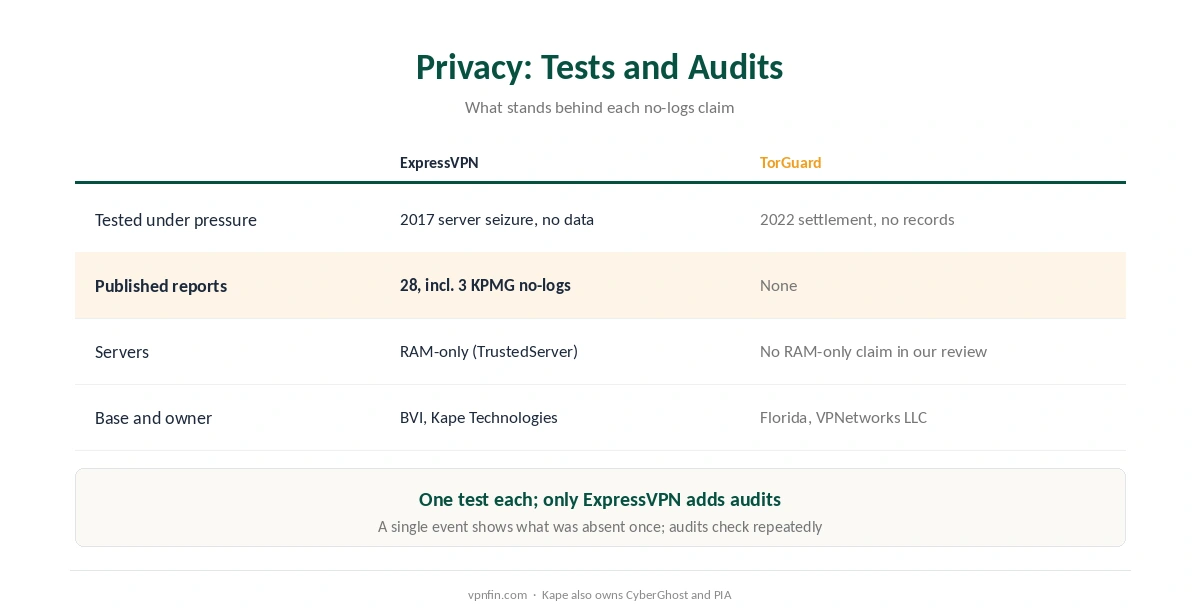
ExpressVPN and TorGuard have both had their no-logs claims tested by people with legal power, and both came through. In 2017 Turkish authorities seized an ExpressVPN server and recovered no usable data. In 2021 film studios sued TorGuard, and it settled the next year without disclosing customer records.
After that, the two diverge sharply. ExpressVPN lists 28 published third-party security reports and runs every server from RAM. TorGuard has never been audited, blocks BitTorrent on its US servers, and sells port forwarding and dedicated IPs to technical users. This page sets them side by side.
ExpressVPN vs TorGuard: The Short Answer
Choose ExpressVPN for most uses. It rates 4.5 in our ExpressVPN review, with published audits, reliable streaming and P2P across its whole network. It does not offer port forwarding.
Choose TorGuard only for port forwarding or dedicated IPs, and only outside the United States, where it still carries BitTorrent. It rates 3.1 in our TorGuard review.
If you want ExpressVPN’s parent company with port forwarding, look at Private Internet Access, which Kape Technologies also owns.
Two Tests Under Pressure
ExpressVPN, 2017. Turkish authorities seized one of its servers during an investigation and, as our review records, recovered no usable data. ExpressVPN has since moved every server to TrustedServer, which runs from RAM and reloads its operating system on each reboot. Our Turkey guide covers the country’s wider rules.
TorGuard, 2021 to 2022. Roughly twenty-five film studios sued, alleging its marketing encouraged infringement. It settled in March 2022 by agreeing to block BitTorrent on its US servers, paid nothing, and disclosed no customer records. The studios had pressed providers to keep logs, so TorGuard’s concession was a protocol block rather than records.
⚠️ Both results support the no-logs claim, but only one company has audits as well. A seized server and a settled lawsuit each show what was not there on one occasion. Audits check the setup repeatedly. Our audit tracker explains the difference.
Audits and Jurisdiction
ExpressVPN lists 28 published third-party security reports, from PwC, KPMG, Cure53 and F-Secure, including three no-logs assessments by KPMG. It is based in the British Virgin Islands and owned by Kape Technologies, which also owns CyberGhost and PIA. Our ownership guide covers Kape’s history.
TorGuard has no audit after more than a decade. VPNetworks LLC runs it from Orlando, Florida, inside the Five Eyes arrangement, and our review notes its apps are closed source.
| Provider | No-logs audits | Auditor | Jurisdiction |
|---|---|---|---|
| NordVPN | 6 | PwC, Deloitte | Panama |
| Surfshark | 2 | Deloitte | Netherlands (9 Eyes) |
| ExpressVPN | 3 | KPMG (28 security reports in total) | British Virgin Islands, Kape-owned |
| CyberGhost | 3 | Deloitte | Romania, Kape-owned |
| PureVPN | 4 | KPMG | BVI, operated from Pakistan |
| IPVanish | 2 | Leviathan, Schellman | United States (Five Eyes), Ziff Davis-owned |
| Windscribe | 1 | Packetlabs, production infrastructure | Canada (Five Eyes); Greek case dismissed, no data to give |
| Proton VPN | 5 | Securitum | Switzerland, moving infrastructure to EU |
| Private Internet Access | 3 | Deloitte | United States (Five Eyes), Kape-owned |
| Mullvad | 10+ | Cure53, Assured AB | Sweden (14 Eyes) |
| TunnelBear | Annual since 2017 | Cure53 | Canada (Five Eyes), US parent |
| Norton VPN | 2 | VerSprite | United States (Five Eyes) |
| Hotspot Shield | 0 | protocol audited, policy not | United States (Five Eyes) |
| AirVPN | 0 | none — the client is open source instead | Italy (14 Eyes) |
| IVPN | 8, annual since inception | Cure53 | Gibraltar (status disputed) |
| Hide.me | 1 modern, in 2024 | Securitum, though one source names Altius IT | Malaysia (outside the alliances) |
| PrivadoVPN | 0 | none in six years of operation | Iceland (moved from Switzerland, 2026) |
| TorGuard | 0 | none; settled a lawsuit without disclosing records | United States (Five Eyes) |
| FastestVPN | 1, in 2023 | Altius IT | Cayman Islands (outside the alliances) |
| StrongVPN | 0 | none in over two decades | United States (Five Eyes), Ziff Davis-owned |
| VyprVPN | 1, in 2018 | Leviathan Security, before the 2023 sale | United States (Five Eyes), Certida-owned since 2023 |
| PrivateVPN | 0 | none; support says there is nothing to audit | Sweden (14 Eyes), ownership disputed |
| ZoogVPN | 0 | none; support describes one as planned | Greece (outside the alliances), run from Ukraine |
| Malwarebytes Privacy VPN | 1, in 2026 | X41 D-Sec, white-box over two months | United States (Five Eyes), runs AzireVPN infrastructure |
| Astrill | 0 | — | Disputed: Seychelles or Liechtenstein |
Torrenting and Port Forwarding
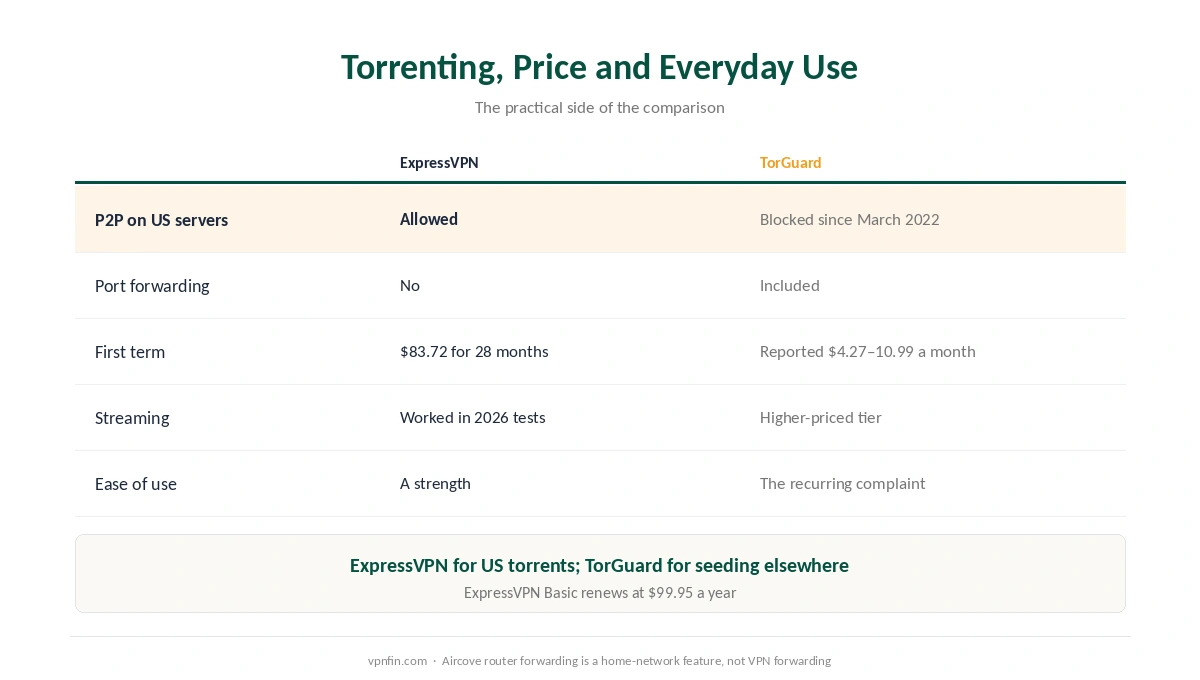
ExpressVPN supports P2P across its whole network, US included, rather than on a dedicated subset of servers. It offers no port forwarding on its VPN servers; its Aircove router, retired from sale in September 2026, has a separate feature for forwarding within your home network, which is a different thing.
TorGuard includes port forwarding but blocks BitTorrent on every US server since the 2022 settlement. Elsewhere it works normally. Our port forwarding guide lists who else offers it, and our torrenting guide explains who needs it.
Price
ExpressVPN Basic costs $83.72 for 28 months on the current offer, then $99.95 a year. Advanced and Pro cost more and add devices. Our ExpressVPN pricing page explains why its 80% discount is measured against the monthly price.
TorGuard’s reported Standard prices run from about $4.27 to $10.99 a month, with streaming on a higher tier and dedicated IPs extra. If you stream, compare against TorGuard’s higher tier rather than its headline price.
Streaming, Devices and Apps
Streaming: ExpressVPN worked with the major Netflix libraries in every 2026 test we found, as our ExpressVPN and Netflix page records. TorGuard puts streaming on a separate tier.
Devices: ExpressVPN allows 10, 12 or 14 by tier, and runs on both Fire TV systems, as our Fire Stick guide explains. TorGuard’s limit depends on the plan.
Obfuscation: both handle restrictive networks. Our obfuscation guide covers how.
Ease of use: ExpressVPN’s apps are among its strengths, while TorGuard’s interface is the recurring complaint in reviews.
What Each One Lacks
ExpressVPN lacks port forwarding and a low renewal. Its Basic plan renews at $99.95 a year, and nothing in its range forwards ports on the VPN servers. It also belongs to a larger group, Kape, whose earlier corporate history our review discusses.
TorGuard lacks audits, open apps and US torrenting. It also lacks a simple price, since streaming and dedicated IPs sit above the entry plan. Its independence is a genuine point in its favour, but it does not substitute for verification.
Neither is the right choice for everyone who torrents. ExpressVPN suits downloading in the United States; TorGuard suits seeding elsewhere. Anyone who needs both should look at PIA first.
Which One
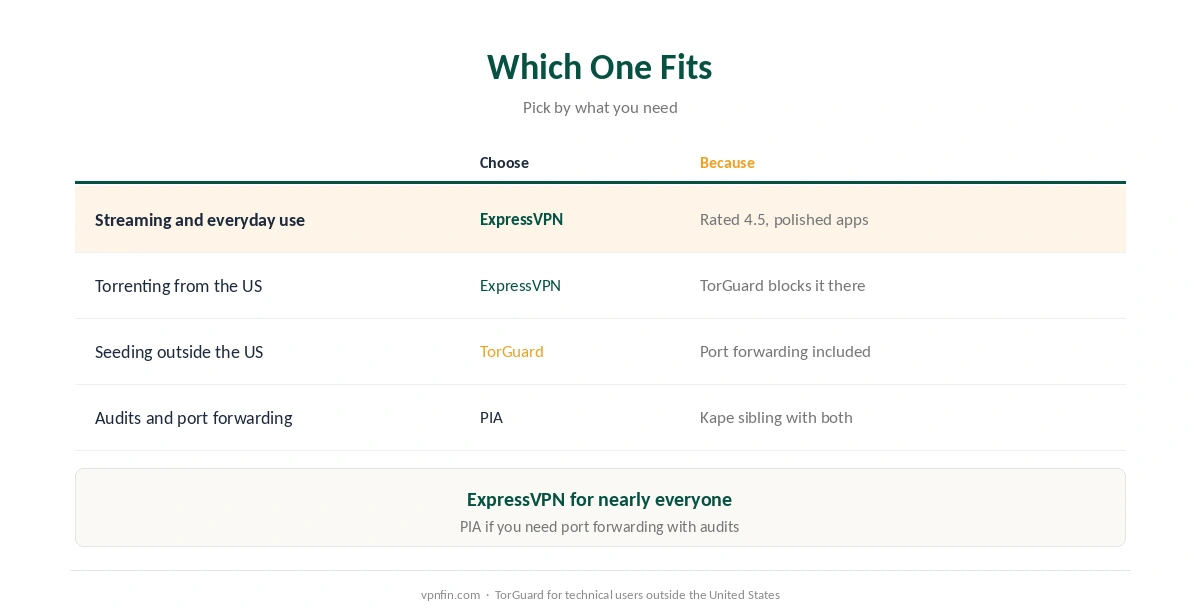
ExpressVPN for streaming, torrenting in the United States, published audits and polished apps.
TorGuard for port forwarding and dedicated IPs outside the United States, if you accept an unaudited provider. NordVPN against TorGuard and Surfshark against TorGuard compare it with two more mainstream rivals, both owned by Nord Security.
For audits and port forwarding together, ExpressVPN against PIA sets out the Kape sibling that offers both.
How We Research
ExpressVPN’s current price comes from its pricing page, read on 25 September 2026, and its audits, server seizure and P2P policy from our ExpressVPN review and tables. TorGuard’s settlement, pricing and ownership come from our TorGuard review, which draws on TorrentFreak, BleepingComputer, Techdirt and others named there. Netflix results come from our ExpressVPN and Netflix page. We do not run our own tests. Our full approach lives on the About Us page.
ExpressVPN vs TorGuard FAQ
For streaming, audited privacy and ease of use, yes. ExpressVPN rates 4.5 against TorGuard’s 3.1 in our reviews. TorGuard’s advantages are port forwarding and dedicated IPs.
Yes, across its whole network, including US servers. It does not offer port forwarding on its VPN servers, which matters mainly for seeding.
A March 2022 settlement with about twenty-five film studios required it to block BitTorrent on its US servers. It paid nothing and disclosed no customer records. Servers elsewhere still allow torrenting.
Both. Turkish authorities seized an ExpressVPN server in 2017 and recovered no usable data. TorGuard settled a studio lawsuit in 2022 without disclosing customer records.
ExpressVPN, with 28 published third-party security reports by its own list, including three no-logs assessments by KPMG. TorGuard has none.
The Verdict
ExpressVPN is the better VPN for nearly everyone. It pairs a tested no-logs claim with audits, streams reliably and allows torrenting everywhere.
TorGuard’s case is port forwarding and dedicated IPs outside the United States. If you need port forwarding with audits behind it, however, PIA is the more natural companion to ExpressVPN than TorGuard.