
Disclosure: VPNFin is reader-supported. If you buy a VPN through links on this page, we may earn a commission at no extra cost to you. This never affects our ratings — here’s our full disclosure.
The CyberGhost cost is unusually simple: its two-year plan costs $56.94, and so does every renewal after it. The checkout page says so in one line: billed $56.94 for the first two years, then $56.94 annually. On a bank statement the figure never changes.
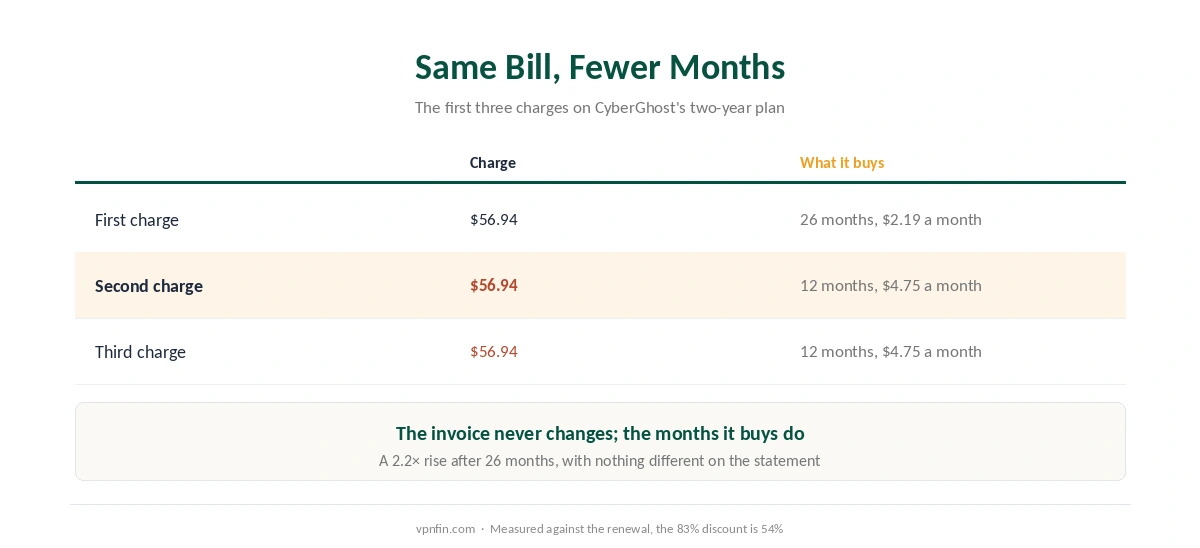
What changes is how long it lasts. The first $56.94 covers 26 months, which the page presents as $2.19 a month. Every $56.94 after that covers 12, which is $4.75 a month. So the renewal does not jump on the invoice, yet the monthly rate still rises 2.2× after 26 months. Even so, it renews for less than Surfshark, ExpressVPN or NordVPN.
CyberGhost Cost: The Short Answer
The two-year plan is $56.94 for 26 months, then $56.94 a year. The six-month plan is $41.94 every six months, and month to month costs $12.99. Every plan covers seven devices.
After the first term, CyberGhost costs $4.75 a month. That is below Surfshark’s reported $79 a year, ExpressVPN’s $99.95 and NordVPN’s $139.08. So over four years it costs less than any of them.
The refund window is 45 days on the six-month and two-year plans, and 14 days on the monthly plan. Our CyberGhost review rates the product 4.3 on everything else.
Every Plan, and What It Renews At
These are the figures CyberGhost’s checkout page showed in US dollars on 25 September 2026. Taxes may apply depending on where you are, as the page notes under the total.
| Plan | First payment | Then |
|---|---|---|
| 2 years + 2 months | $56.94 for 26 months | $56.94 a year |
| 6 months | $41.94 for 6 months | $41.94 every 6 months |
| 1 month | $12.99 | $12.99 a month |
Only the two-year plan changes shape at renewal. The six-month and monthly plans renew at exactly what they cost the first time, for exactly the same length. The long plan renews at the same amount for a shorter period, which is why the per-month figure rises while the invoice does not.
The Same Bill, Fewer Months
It is still a price rise. Your first $56.94 buys 26 months at $2.19 each, and the second buys 12 months at $4.75. So the rate per month goes up 2.2× after 26 months, even though no number on your statement moves.
The rise is gentler than elsewhere, though. NordVPN’s entry plan goes up 3.3× after 27 months, and ExpressVPN’s 2.8× after 28 months on its current offer. CyberGhost’s jump is the smallest of the three, and its renewal amount is the smallest in absolute terms too. Our NordVPN pricing page and our ExpressVPN pricing page show those figures in full.
The discount is measured the usual way. The page says its 83% is a reduction from the $12.99 monthly price, and the struck-out $337.74 is exactly 26 months at $12.99. Measured against the renewal instead, 26 months would cost $123.37, so the real saving is 54%.
⚠️ The renewal is still worth checking. Gizmodo’s review this month quoted $51.74 for 26 months, renewing at $51.74 a year, through its own partner link. Prices through partner links, including ours, can differ from the direct page.
Four Years on Each Entry Plan
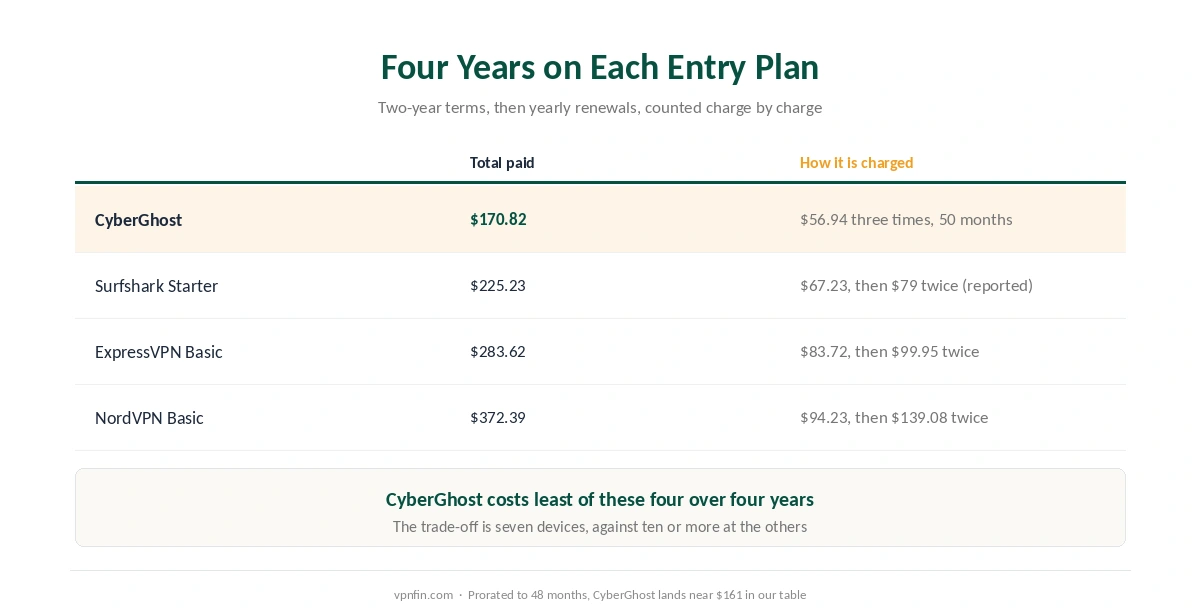
Here is what leaves your account over four years on the two-year plan, counted charge by charge.
CyberGhost: $170.82 in three charges of $56.94, covering 50 months.
Surfshark Starter: $225.23, using its reported renewal. Our Surfshark price page explains why that renewal is reported rather than quoted.
ExpressVPN Basic: $283.62 on the current offer.
NordVPN Basic: $372.39.
CyberGhost’s six-month plan would cost $335.52 over the same four years, in eight charges. Month to month it would cost $623.52. Prorated to exactly 48 months, our four-year table puts the two-year plan near $161, which is the top of the range it shows.
Which CyberGhost Plan to Choose
For three months or less, pay monthly. Three months at $12.99 comes to $38.97, which is less than the six-month plan’s $41.94. From the fourth month the monthly plan costs more, at $51.96 for four.
For four to six months, the six-month plan is cheaper than paying monthly. However, the two-year plan costs only $15.00 more than one six-month term and runs for 20 months longer, with the same 45-day refund.
For anything longer, the two-year plan wins outright. A year on the six-month plan costs $83.88, against $56.94 on the two-year plan, even if you cancel after twelve months. In practice, the six-month plan only makes sense if you are certain you will stop within half a year.
What $56.94 a Year Does Not Cover
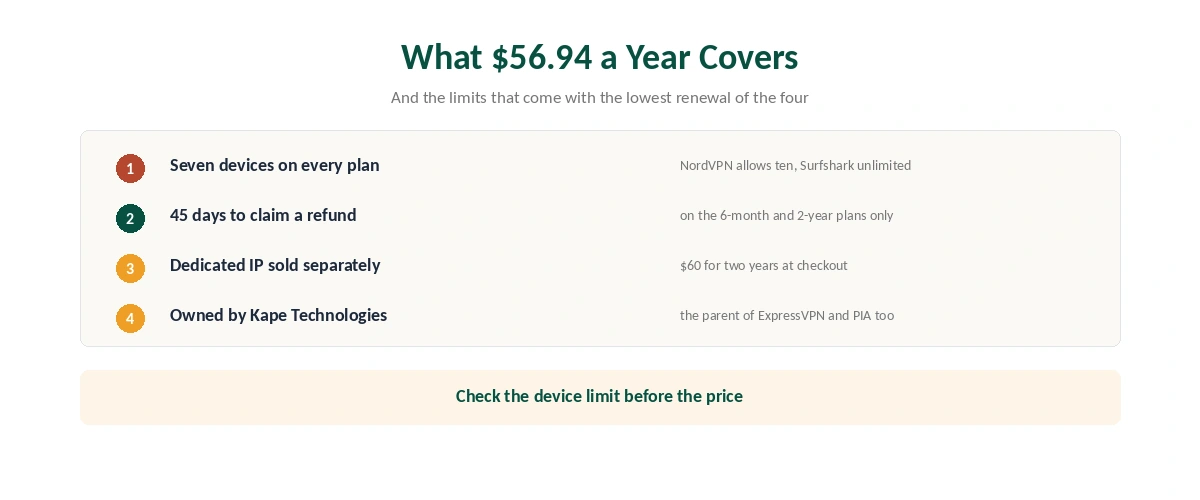
Seven devices is the limit. NordVPN allows ten on every plan, ExpressVPN ten to fourteen by tier, and Surfshark unlimited. At renewal CyberGhost works out at $8.13 a year per device, which is cheap per connection but may not stretch across a large household. Our multi-device guide compares the options.
A dedicated IP costs extra. The checkout page prices it at $5 a month, or $60 for two years, which is $2.50 a month. Our dedicated IP guide covers who needs one.
Other add-ons are offered at checkout. They include a Windows security suite for $24 over two years and a password manager for $31.98. The ID Guard breach monitor, by contrast, is included free. Neither paid add-on is required, and each one adds to the renewal if you keep it.
How CyberGhost’s Renewal Compares
CyberGhost belongs to Kape Technologies, which also owns ExpressVPN and Private Internet Access, as our ownership guide sets out. The same group charges $43.01 a year more to renew ExpressVPN Basic.
ExpressVPN against CyberGhost covers what that difference buys. CyberGhost against PIA compares the two cheaper Kape brands.
Outside Kape, the comparisons that matter are with Nord Security’s two brands. Surfshark against CyberGhost sets unlimited devices against a lower renewal. NordVPN against CyberGhost shows what the higher price buys in speed and audits.
For every provider’s renewal side by side, see our renewal price table, and our cheap VPN guide for the four-year rankings.
Refunds and the Free Trial
CyberGhost gives 45 days to claim a refund on the six-month and two-year plans, and 14 days on the monthly one. That is fifteen days more than NordVPN, Surfshark or ExpressVPN allow on their long plans. The table below sets it against every provider we track.
| Provider | Refund window | No-card trial |
|---|---|---|
| NordVPN | 30 days | No |
| Surfshark | 30 days | No |
| ExpressVPN | 30 days | No |
| CyberGhost | 45 days | 24 hrs desktop |
| PureVPN | 31 days | No, 7-day paid trial |
| IPVanish | 30 days | 7-day app store trial |
| Windscribe | 3 days | free tier up to 15GB |
| Proton VPN | 30 days, prorated in practice | free plan, no data cap |
| Private Internet Access | 30 days | No |
| Mullvad | 30 days, unused time returned | No |
| TunnelBear | None | free tier, 2 GB a month |
| Norton VPN | 60 days annual, 14 monthly | No |
| Hotspot Shield | 45 days | 7-day trial |
| Astrill | Disputed: none or 7 days | No |
There is also a 24-hour trial on desktop that does not ask for payment details, as our free trial guide records. A day is short for a real test, so the 45-day window is the more useful safety net.
To claim a refund, contact support within the window. Our refund guide covers the steps and the conditions across providers.
Who Should Pay for CyberGhost
Buyers who will stay beyond the first term. Its renewal undercuts the other three brands priced above, and the gap grows every year you stay.
Anyone who wants time to decide. Forty-five days is long enough to test streaming, travel and home use properly.
Households with seven devices or fewer. At that size the device limit costs nothing.
Who Should Look Elsewhere
Large households. Surfshark’s unlimited connections cost $22.06 a year more at renewal on its reported figure, which may be worth it above seven devices.
Buyers who want the strongest audit record. CyberGhost’s no-logs policy has been assessed by Deloitte, and our audit tracker sets that record against NordVPN’s and ExpressVPN’s.
Month-to-month buyers. At $12.99 a month with a 14-day refund, the short plan gives up most of what makes CyberGhost attractive.
How We Research
Every CyberGhost price here comes from its checkout page in US dollars, read on 25 September 2026, including the renewal line and the note on how discounts are measured. The disagreeing figure comes from Gizmodo’s review, named where used. Other providers’ prices come from our own pricing pages, and the refund windows, device limits and ownership from our tables. The per-month rates, the multipliers, the four-year totals and the discount recalculated against the renewal are our own arithmetic. Taxes are extra, and prices can vary by country. We do not run our own tests. Our full approach lives on the About Us page.
CyberGhost Cost FAQ
$2.19 a month on the two-year plan, paid upfront as $56.94 for 26 months. The six-month plan works out at $6.99 a month, and month to month costs $12.99.
The bill stays at $56.94, but it then covers 12 months instead of 26. So the monthly rate rises from $2.19 to $4.75, which is 2.2× after 26 months, with no change on your statement.
At renewal, yes. CyberGhost renews at $56.94 a year, against Surfshark’s reported $79 and NordVPN’s $139.08. Over four years on two-year plans it costs $170.82, against $225.23 and $372.39.
Seven on every plan. NordVPN allows ten and Surfshark unlimited, so check the limit against your household before buying.
45 days on the six-month and two-year plans, and 14 days on the monthly plan. There is also a 24-hour desktop trial without payment details.
The Verdict
CyberGhost costs $56.94 for your first 26 months, and $56.94 a year after that. The invoice stays flat while the months shrink, so the real rate still rises 2.2× after 26 months. Even so, it renews for less than Surfshark, ExpressVPN or NordVPN.
If seven devices is enough, the two-year plan is the cheapest way to keep a mainstream VPN for four years. Buy it, use the 45 days to test it properly, and remember that the second $56.94 buys a year rather than two.