
Disclosure: VPNFin is reader-supported. If you buy a VPN through links on this page, we may earn a commission at no extra cost to you. This never affects our ratings — here’s our full disclosure.
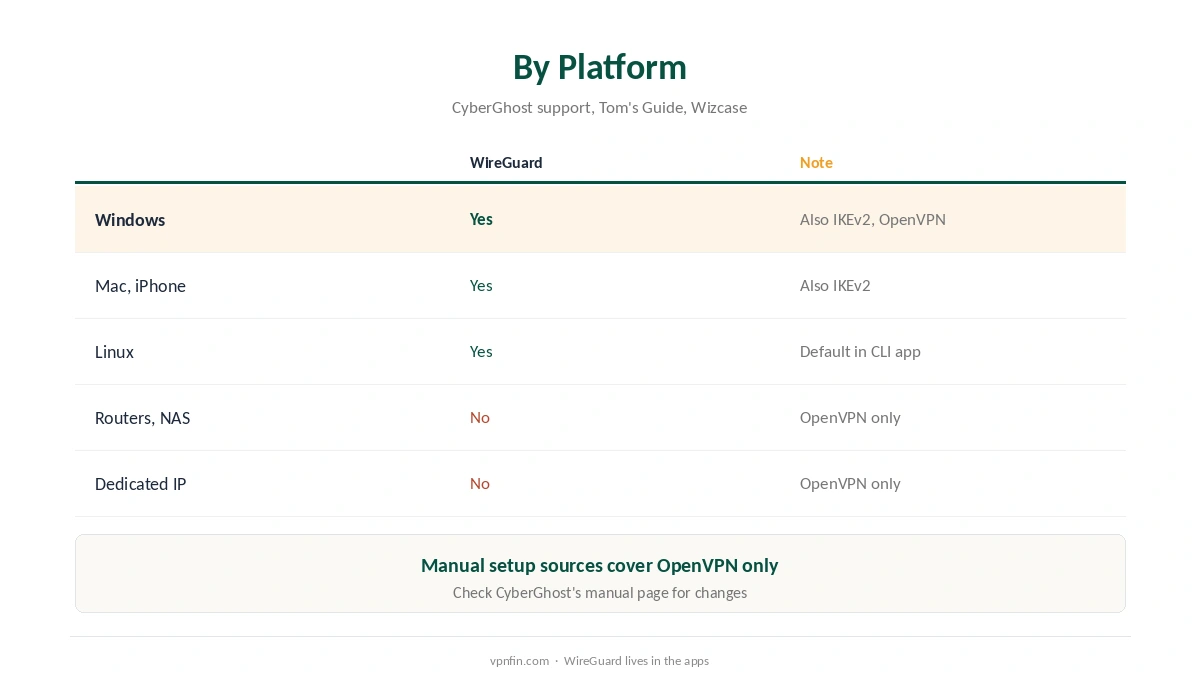
CyberGhost WireGuard is the provider’s main protocol, Netzwelt notes, and it runs in the Windows, Mac, iPhone and Linux apps. The gap is manual setups: CyberGhost’s manual configurations use OpenVPN, and an answer on the GL.iNet forum says WireGuard is available only in the apps, not for routers. So routers and NAS units fall back to OpenVPN.
This guide covers where WireGuard runs, how to choose it, where it is missing, and when to switch.
Where CyberGhost WireGuard Is Available
CyberGhost’s Windows support lists WireGuard with IKEv2 and OpenVPN. Tom’s Guide and Insider Gaming report WireGuard and IKEv2 on iPhone and Mac. On Linux, Parrainduweb found WireGuard as the default in CyberGhost’s command-line app, and Wizcase confirms it is available there. WizCase belongs to Kape, which also owns CyberGhost, so we weigh its findings alongside independent sources.
Our CyberGhost Windows guide, Mac guide and Linux guide show where the protocol setting sits.
Why WireGuard Is the Default
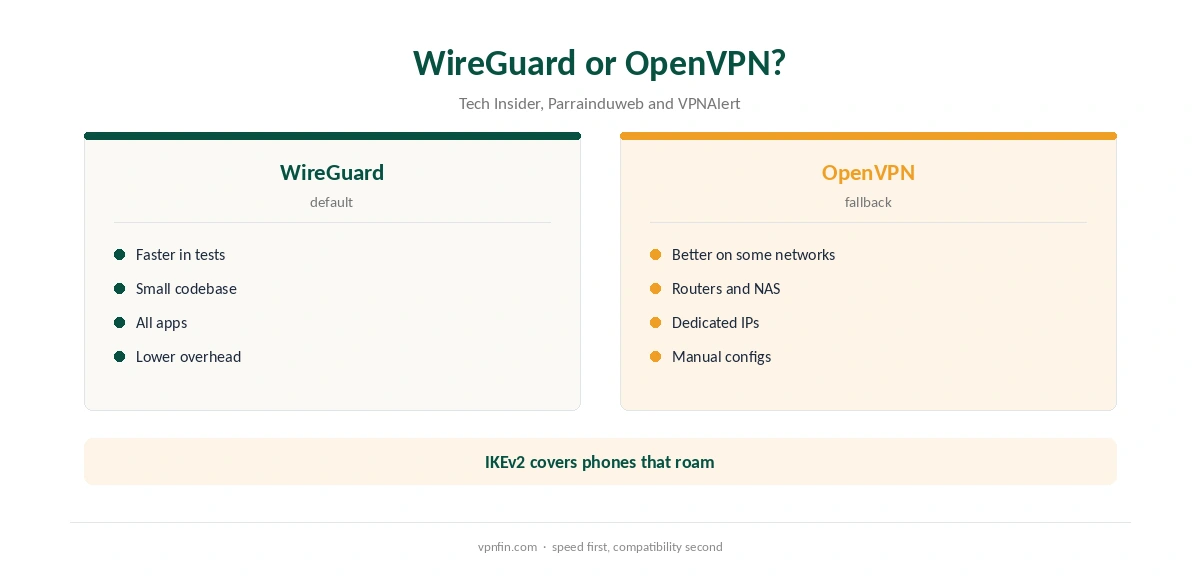
WireGuard uses a small codebase and modern cryptography, which keeps overhead low. It was faster than OpenVPN and IKEv2 in the 2026 gigabit test Tech Insider reported. Parrainduweb found it clearly faster than OpenVPN on Ubuntu in its own tests of CyberGhost.
For streaming, downloads and gaming, start with WireGuard. Our WireGuard vs OpenVPN page explains the design differences.
Where CyberGhost WireGuard Is Missing
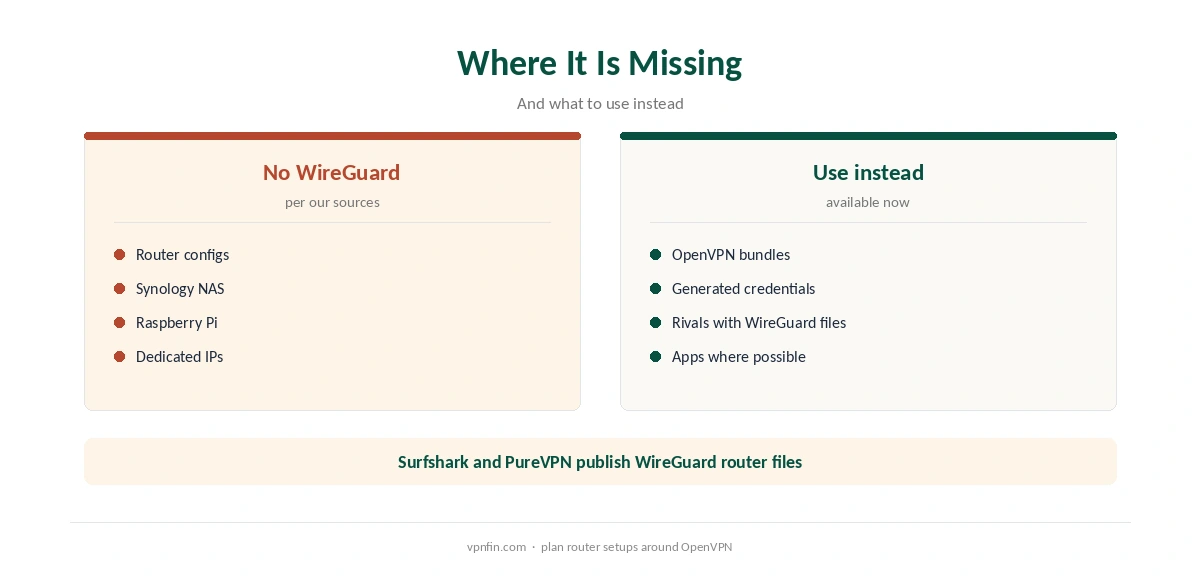
The manual setup sources we read cover only OpenVPN for CyberGhost. NAT Checker describes OpenVPN bundles for Linux NetworkManager, routers and NAS units, and the GL.iNet forum answer says CyberGhost offers WireGuard only in its apps. That forum thread is not recent, so check CyberGhost’s manual setup page for changes.
For now, routers, Synology units and Raspberry Pi boards use OpenVPN, as our CyberGhost router guide and OpenVPN guide explain.
Providers that publish WireGuard files for routers include Surfshark and PureVPN, as our Surfshark WireGuard guide shows. If WireGuard on a router matters to you, that is a reason to compare them.
Switching to CyberGhost WireGuard
In the Windows, Mac and iPhone apps, open the settings and choose WireGuard in the protocol menu. On Linux, Parrainduweb notes WireGuard is already the default, with a command to switch back if you changed it. After switching, reconnect to apply the change.
If the option is greyed out, update the app first. Older versions may list fewer protocols.
WireGuard on Phones and Battery
In the comparisons we read, WireGuard does less work per packet than OpenVPN, which helps battery life on phones. CyberGhost WireGuard is therefore a sensible default on iPhone. If a phone drops the connection while switching networks, IKEv2 is the alternative.
Dedicated IPs and WireGuard
VPNAlert reports that CyberGhost’s dedicated IPs work only over OpenVPN. If you add a dedicated IP, expect to use OpenVPN for that address and WireGuard for regular servers. Our CyberGhost dedicated IP guide covers the add-on.
When to Switch Away From WireGuard
VPNAlert notes OpenVPN performs better on some networks. If WireGuard connects but crawls, or fails on a hotel or office network, try OpenVPN. On a phone that drops as it moves between networks, try IKEv2, as our CyberGhost IKEv2 guide explains.
When WireGuard Will Not Connect
WireGuard runs over UDP, which some hotel, school and office networks block. If CyberGhost WireGuard fails on one network but works elsewhere, the network is the likely cause. Switch to OpenVPN on that network, and back to WireGuard at home.
If it fails everywhere, update the app, restart it, and try another server. CyberGhost’s Windows support also lists repairing the virtual network card and pausing security software as fixes. Our CyberGhost not connecting guide walks through them in order.
Post-Quantum Protection
Several providers now add post-quantum key exchange to WireGuard-based connections. We found no CyberGhost statement on it in the sources we read. Our post-quantum VPN guide explains what the protection does, if it matters to you.
A Quick Rule for CyberGhost WireGuard
Use CyberGhost WireGuard by default in every app. Switch to IKEv2 on a phone that keeps dropping as it moves between networks, and to OpenVPN on networks that block UDP or when you use a dedicated IP. Routers and NAS units start on OpenVPN until CyberGhost publishes WireGuard files for them. Revisit the choice after app updates.
What CyberGhost Costs
CyberGhost renews at $56.94 a year on its 2-year plan, according to our renewal table. It covers seven devices. The 45-day money-back guarantee applies to website purchases, as our CyberGhost refund guide explains.
| Provider | Renewal price | Per month | Tier |
|---|---|---|---|
| NordVPN | $139.08/yr | ~$11.59 | Basic |
| Surfshark | ~$79/yr | ~$6.58 | Starter |
| ExpressVPN | $99.95/yr | ~$8.33 | Basic |
| CyberGhost | $56.94/yr | ~$4.75 | 2-year |
| PureVPN | $47.95/yr | ~$4.00 | Standard, 2-year (1-year renews $57.95) |
| IPVanish | $89.99/yr | ~$7.50 | Essential |
| Windscribe | ~$69/yr | ~$5.75 | Pro |
| Proton VPN | ~$83.88/yr | ~$6.99 | VPN Plus |
| Mullvad | ~$65/yr | ~$5.40 | flat, no tiers |
| Norton VPN | $79.99/yr | ~$6.67 | Standard |
| Hotspot Shield | ~$95.99/yr | ~$8.00 | Premium annual |
| Astrill | $300 every 2 yrs | ~$12.50 | 2-year, same at renewal |
Testing the Connection
After switching, check your IP with our VPN test page and compare speeds with OpenVPN on the same server. If speeds disappoint, our CyberGhost speed guide lists the other fixes. For rivals’ WireGuard setups, see our PureVPN WireGuard guide. CyberGhost belongs to Kape Technologies, which also owns ExpressVPN and Private Internet Access.
How We Research
This page draws on CyberGhost’s Windows support article, Netzwelt, Tom’s Guide, Insider Gaming, Wizcase, Parrainduweb, NAT Checker, a GL.iNet forum thread, VPNAlert and Tech Insider’s protocol test, plus our renewal table. We cross-checked these sources against each other, and where they conflict or something can’t be verified, we say so in the text rather than guessing. We checked time-sensitive figures, including prices in US dollars, on 6 October 2026. Renewal from our renewal table. The main source we relied on is Netzwelt’s CyberGhost test. Our full approach lives on the About Us page.
CyberGhost WireGuard FAQ
Yes, as its main protocol in the Windows, Mac, iPhone and Linux apps.
Not in the sources we read. Manual setups use OpenVPN; check CyberGhost’s site for changes.
Yes in most tests, including Parrainduweb’s on Ubuntu, though OpenVPN does better on some networks.
VPNAlert reports they work only over OpenVPN.
On networks where it fails or crawls, try OpenVPN; on phones that roam, try IKEv2.
The Verdict
CyberGhost WireGuard is the fast default in every app. Manual setups and dedicated IPs still rely on OpenVPN, so router and NAS users should plan around that.