
Disclosure: VPNFin is reader-supported. If you buy a VPN through links on this page, we may earn a commission at no extra cost to you. This never affects our ratings — here’s our full disclosure.
Every cheap VPN guide ranks providers by the advertised monthly rate. That number applies to your first term only, and after it expires most providers renew at two to four times the price. This guide ranks by what you actually pay — first term plus renewals — and the order is not the same. One provider that looks mid-priced on day one becomes the most expensive of the five within four years.
The Short Answer
Cheapest overall: PureVPN, at roughly $148 across four years. It is also the only provider here with a documented logging incident, which we cover honestly below.
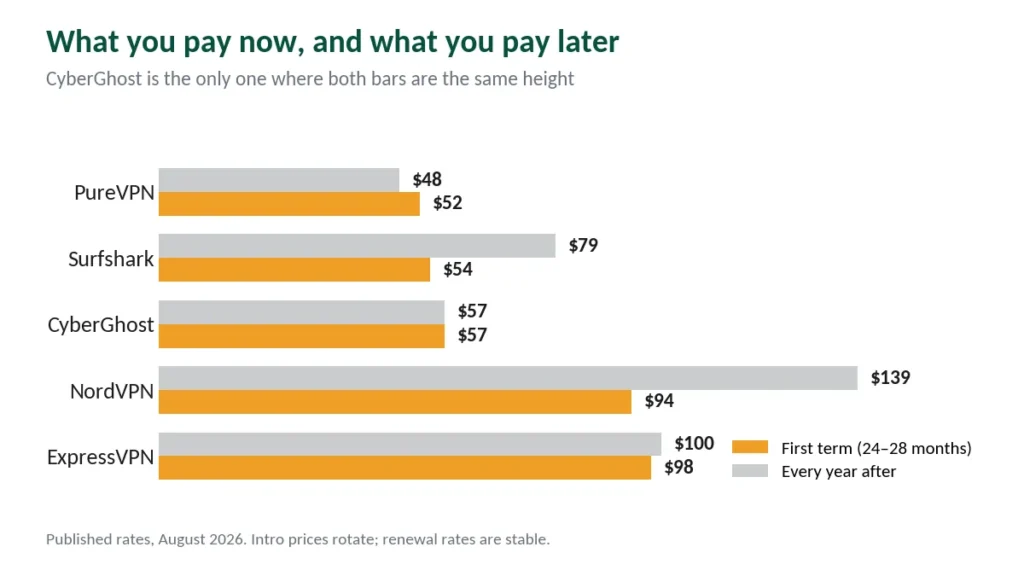
Best value: CyberGhost. It renews at $56.94 a year, the same dollar figure as the two-year plan — though that first payment covers 28 months rather than 12, so the monthly cost still climbs from $2.03 to $4.75.
Most expensive over time: NordVPN, despite a competitive intro price, because it renews at $139.08 a year.
What Each One Actually Costs
Two numbers matter: what you pay for the first term, and what you pay every year afterwards.
| Provider | First term | Every year after |
|---|---|---|
| Norton VPN | $39.99 (12 months) | $79.99 |
| Private Internet Access | ~$49 (24 months) | Sources disagree |
| PureVPN | ~$52 (24 months) | $47.95 |
| Surfshark | ~$54 (27 months) | ~$79 |
| CyberGhost | $56.94 (26 months) | $56.94 |
| Mullvad | ~$65 (12 months) | ~$65 |
| Proton VPN | ~$71.76 (24 months) | $83.88 |
| Hotspot Shield | ~$71.88 (12 months) | $95.99 |
| NordVPN | ~$94 (27 months) | $139.08 |
| ExpressVPN | ~$98 (28 months) | $99.95 |
⚠️ Intro prices rotate constantly and first terms run different lengths — 24 to 28 months depending on the bonus months included. Check the figure at checkout rather than trusting any review, including this one. Renewal rates are stable, which is why we weight them more heavily.
The Four-Year Maths
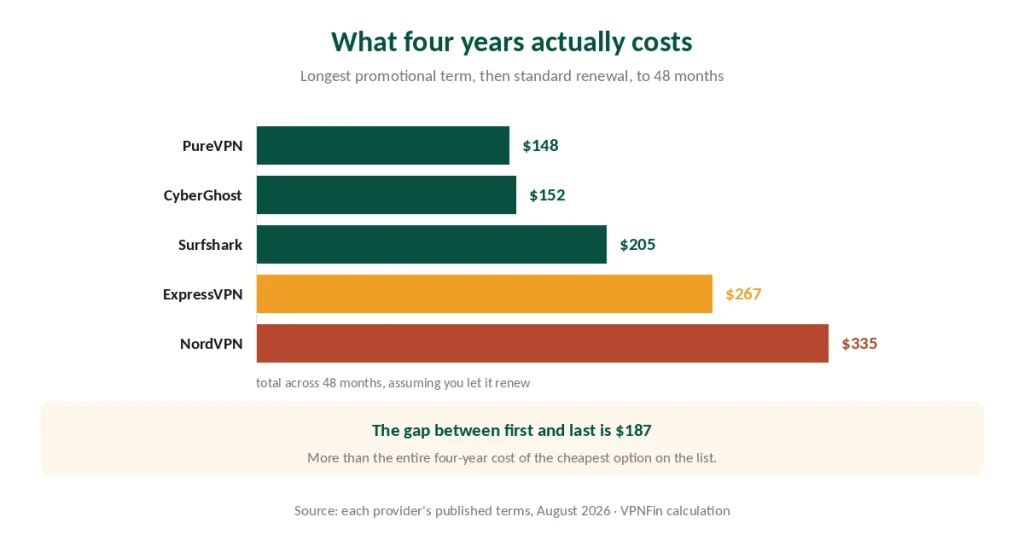
Here is where the ranking changes. Approximate total cost of ownership over 48 months, assuming you keep the subscription and let it renew:
| Provider | 4-year total |
|---|---|
| PureVPN | ~$148 |
| CyberGhost | ~$152 |
| Surfshark | ~$205 |
| ExpressVPN | ~$267 |
| NordVPN | ~$335 |
| TunnelBear | ~$160 |
| Proton VPN | ~$240 |
| Mullvad | ~$260 |
| Norton VPN | ~$280 |
| Hotspot Shield | ~$290–360 |
The finding worth pausing on: NordVPN costs roughly $68 more than ExpressVPN over four years, despite starting cheaper. ExpressVPN has spent years being described as the expensive option; on this measure it is not. We reach the same conclusion from a different angle in our NordVPN vs ExpressVPN comparison.
And the gap between top and bottom is $187 — more than the entire four-year cost of the cheapest option.
A sixth data point: IPVanish renews at $89.99 a year after a $39.99 first year — between Surfshark and ExpressVPN, and the only one of the six with unlimited devices at that price. Against NordVPN it saves $49 a year, and loses on speed at distance. A seventh: PIA runs around $2 a month on a two-year plan, the lowest of any independently audited provider — though its renewal figure isn’t documented in published sources. And one provider sits outside this arithmetic entirely: Mullvad has charged €5 a month since 2009, with no promotional rate to expire. Every other provider raises its price, and we have now tabulated all ten on the same basis.
The Five, Ranked by Value
1. CyberGhost — Best Value
Not the cheapest on day one, but the only provider whose renewal doesn’t punish you for staying. CyberGhost’s own checkout states the plan renews at $56.94 a year — the same total you paid upfront, charged annually instead of biennially.
You also get the longest refund window in the category at 45 days, and a genuine 24-hour desktop trial requiring no payment card. Three Deloitte no-logs audits back the privacy claim, and Romania sits outside every intelligence-sharing bloc.
Trade-offs: seven simultaneous devices, the lowest here, and 31–38% speed loss in independent testing. Full detail in our CyberGhost review.
2. PureVPN — Cheapest Overall
At roughly $148 across four years, nothing here costs less. It is also the only provider in our top five offering port forwarding, though as a paid add-on at $0.99 a month rather than an included feature — which matters if you seed on private trackers, as our torrenting guide explains. PIA includes it at no extra cost, at a comparable price.
The honest caveat: PureVPN supplied connection logs to the FBI in 2017 while marketing a no-logs policy. It has since passed four KPMG audits and operates an unusual always-on audit arrangement, but the history is real and we cover it fully in our PureVPN review. Cheapest is not automatically best value if the record matters to you.
3. Surfshark — Cheapest for Households
Around $205 over four years, and the only provider here with unlimited simultaneous connections. If you are covering more than seven devices, the per-device cost makes it the cheapest option by a wide margin — nothing else scales without a higher tier.
Renewal at roughly $79 a year is mid-range — within $5 of Proton VPN, which most comparisons miss. Two Deloitte audits, Netherlands jurisdiction. Full detail in our Surfshark review.
⚠️ One source we checked reports Surfshark renewing at $15.45 a month rather than $79 a year — that figure appears to be the month-to-month rate rather than the renewal. We use $79 based on the more consistent sources, but verify at checkout.
4. ExpressVPN — Expensive, But Less Than You’d Think
Roughly $267 over four years, and it buys the deepest published verification record in the category — a published audit record nobody can agree on the size of, counted as 18, 19, 27 and 28 across different sources — plus the most reliable access on restricted networks and the easiest apps.
Not cheap. But cheaper than NordVPN on this measure, which contradicts its reputation. Full detail in our ExpressVPN review. Against its own sibling CyberGhost, though, it costs $43 a year more.
5. NordVPN — Best Product, Highest Bill
Roughly $335 over four years, the most expensive here. What that buys: the fastest speeds by a wide margin — 2.9% loss against 18–38% for the rest — six no-logs audits, and Panama jurisdiction.
If speed is your first criterion, this is the one, and our NordVPN review covers why. If price is, it isn’t — Proton VPN renews at $55 a year less for a service that loses a few more percent of your speed.
Why “Cheap” and “Good Value” Aren’t the Same
Three things worth weighing against the headline number.
Devices. Surfshark at $205 covering fifteen devices costs $13.67 per device over four years. CyberGhost at $152 covering seven costs $21.71. The cheaper total is not the cheaper outcome.
Refund window. CyberGhost gives 45 days to change your mind, everyone else 30. Longer windows lower the risk of paying for something that doesn’t work for you — our free trial guide covers the conditions attached to each.
What you’re buying. The cheapest option here carries a documented logging incident. The most expensive is the fastest by a factor of six. Neither fact appears in a price table, and both matter more than $50 spread across four years — across nine providers, price and our rating turn out to be unrelated entirely.
How to Actually Pay Less
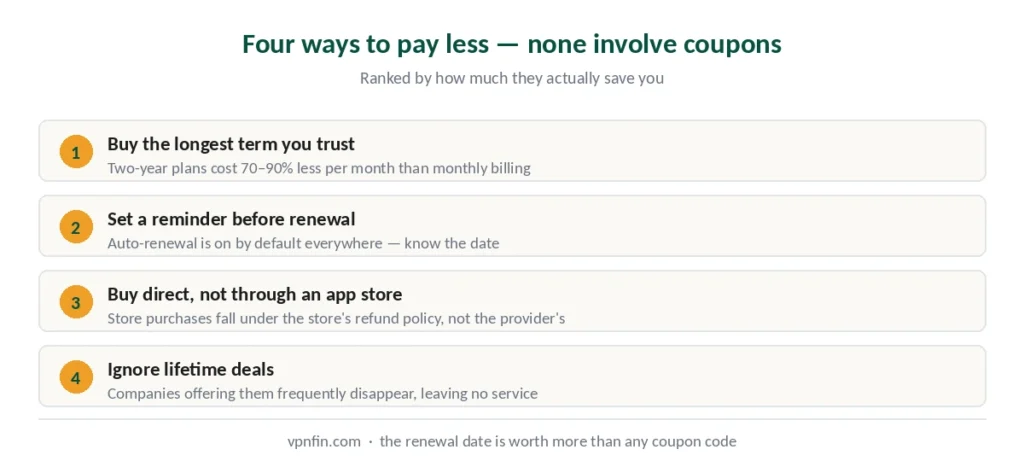
A short list of things that work, none of which involve coupon hunting — including the student route, which is smaller than it advertises — and our main ranking weighs the renewal figure as heavily as the first-term price for the same reason.
Buy the longest term you’re confident about. The two-year plans cost 70–90% less per month than monthly billing. That saving is real, and it is the single biggest lever.
Set a reminder before renewal. Auto-renewal is on by default everywhere. Knowing the renewal date lets you decide rather than discover.
Buy direct from the provider’s site. App store purchases fall under the store’s refund policy rather than the provider’s, and the provider’s is usually more generous.
Ignore lifetime deals, with one qualification. They are consistently flagged as unreliable, because the companies offering them often disappear. We examined the strongest exception and it still comes down to a bet on the company surviving.
And check whether waiting for Black Friday would change anything. For at least two of the providers in the table above, last November’s sale price is the price they charge in any month of the year.
How We Research
This guide draws on our full reviews of all five providers, renewal figures taken from each provider’s own checkout terms, and pricing comparisons from named sources — cross-checked and verified at publication. Four-year totals are our own calculations from published intro and renewal prices, and they are approximations: first terms run different lengths and promotional rates rotate. Where sources conflicted, notably on Surfshark’s renewal figure, we say so. Our full approach lives on the About Us page.
Cheap VPN FAQ
PureVPN, at roughly $148 across four years including renewals. On first-term price alone it also leads, at around $52 for 24 months. CyberGhost is close behind and arguably better value, because it renews at the same price you paid upfront rather than increasing.
Introductory rates are acquisition pricing — providers discount heavily to win the sale, then renew at closer to standard rates. Most convert from a two-year plan to annual billing at two to four times the effective monthly rate. CyberGhost is the exception among the providers we rank, renewing at the same total.
Paid budget VPNs from established providers are generally fine — CyberGhost and PureVPN both publish independent no-logs audits. Free VPNs are the actual risk: data caps make them impractical, and some monetise by logging and selling the browsing data a VPN is supposed to protect — though three of them are genuinely safe, and we cover which.
Surfshark, because it allows unlimited simultaneous connections at roughly $205 over four years. Covering fifteen devices works out to about $13.67 per device across that period — nothing else here comes close, since every other provider caps connections between seven and fourteen.
No. They are consistently flagged as unreliable across the industry: companies offering them frequently disappear, leaving subscribers without service and without recourse. Running a VPN network costs money continuously, and a one-off payment cannot fund it indefinitely.
Set a calendar reminder for two days before your term ends — 28 days for most providers, 43 for CyberGhost’s long plans. That gives you time to cancel, compare, or negotiate before auto-renewal charges you. Buying direct from the provider’s website rather than an app store also keeps you under the provider’s own refund policy.
The Verdict
CyberGhost if you want the least unpleasant surprise — it is the only provider here that charges the same on renewal as it did upfront, and it gives you 45 days to decide.
PureVPN if the absolute lowest number is what matters, and you have read the 2017 section of our review and made your peace with it.
Surfshark if you have a household of devices, where per-device cost makes it cheapest by some distance.
And whatever you choose: note the renewal price at purchase. That single habit is worth more than any coupon code on this page.