
Disclosure: VPNFin is reader-supported. If you buy a VPN through links on this page, we may earn a commission at no extra cost to you. This never affects our ratings — here’s our full disclosure.
StrongVPN traces its roots to 1994, when it was an internet service provider. In more than two decades since, it has never published an independent audit of anything.
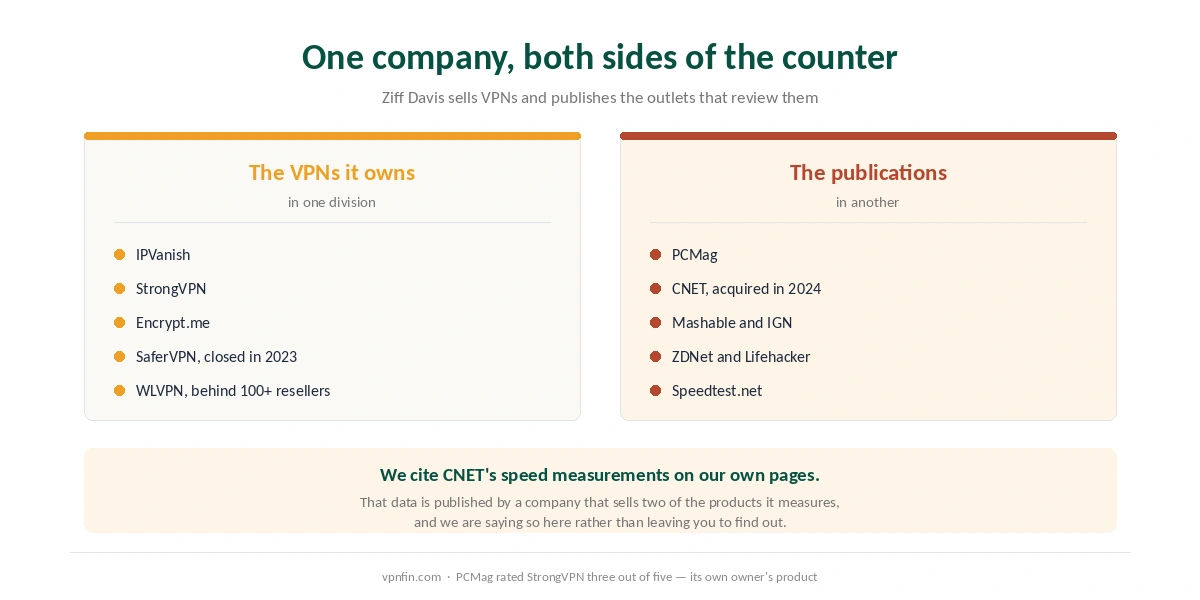
It also belongs to the company that owns PCMag, CNET, Mashable, IGN and Speedtest.net. That matters for this review in a way we will come to, because we cite one of those outlets ourselves.
Is StrongVPN Any Good?
It runs its own server hardware instead of renting capacity, which is genuinely unusual and gives it direct control over load and maintenance. Twelve simultaneous connections, WireGuard by default, and a dedicated IP address if you want one.
Torrenting is permitted across the network, and obfuscation is offered under the name Scramble on Windows and macOS.
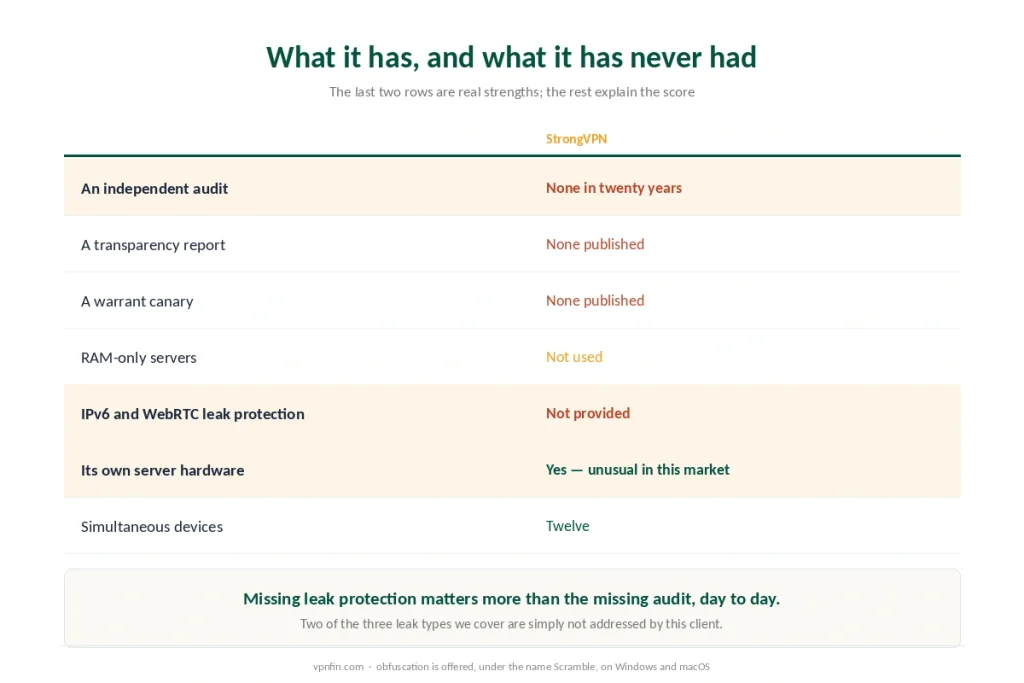
⚠️ And there is nothing to verify any of it. No independent audit, no transparency report, no warrant canary, and no court test — in a United States jurisdiction, over more than twenty years.
Who Owns It, and Why We Are Leading With That
Ziff Davis, formerly j2 Global. The chain runs Highwinds to StackPath in 2017, then to Ziff Davis in 2019 through its NetProtect division.
The same company owns IPVanish, Encrypt.me and the WLVPN white-label platform that sits behind more than a hundred resold VPN services. SaferVPN was merged into StrongVPN and closed in late 2023.
And it owns PCMag, CNET, Mashable, IGN, ZDNet, Lifehacker and Speedtest.net. Publications that review VPNs, and the speed-testing tool people use to measure them.
⚠️ This affects us directly, so we are saying it plainly. Our page on VPN speed loss cites CNET’s measurements of several providers. CNET has been owned since 2024 by the company that sells two of the products it tests. The data may be perfectly sound — but you should know where it comes from, and that page names its sources for exactly this reason.
To its credit, PCMag rated StrongVPN three out of five — its own owner’s product, publicly, with the conflict disclosed. That is better behaviour than some of the arrangements on our ownership map.
Its sibling under the same owner has been audited twice, and this one never — IPVanish against StrongVPN.
It is also one of two providers we cover that own their server hardware — compared directly here.
What Is Missing
No independent audit, in over twenty years. Cure53 has examined ExpressVPN, Surfshark, Mullvad and others; Deloitte has examined NordVPN six times. StrongVPN has published nothing, and a policy without verification is the weakest claim in this category.
No transparency report and no warrant canary. Both are cheap to publish. Their absence in a United States jurisdiction means you cannot tell whether the company has been served with anything.
⚠️ And no protection against IPv6 or WebRTC leaks. That is the one to notice, because it affects you every day rather than hypothetically — the IPv6 and WebRTC leaks we cover elsewhere are simply not addressed by this client.
No RAM-only servers either, which is now standard among the providers we rank highest.
| Provider | No-logs audits | Auditor | Jurisdiction |
|---|---|---|---|
| NordVPN | 6 | PwC, Deloitte | Panama |
| Surfshark | 2 | Deloitte | Netherlands (9 Eyes) |
| ExpressVPN | 3 | KPMG | British Virgin Islands, Kape-owned |
| CyberGhost | 3 | Deloitte | Romania, Kape-owned |
| PureVPN | 4 | KPMG | BVI, operated from Pakistan |
| IPVanish | 2 | Leviathan, Schellman | United States (Five Eyes), Ziff Davis-owned |
| Windscribe | 1 | Packetlabs, production infrastructure | Canada (Five Eyes); Greek case dismissed, no data to give |
| Proton VPN | 5 | Securitum | Switzerland, moving infrastructure to EU |
| Private Internet Access | 3 | Deloitte | United States (Five Eyes), Kape-owned |
| Mullvad | 10+ | Cure53, Assured AB | Sweden (14 Eyes) |
| TunnelBear | Annual since 2017 | Cure53 | Canada (Five Eyes), US parent |
| Norton VPN | 2 | VerSprite | United States (Five Eyes) |
| Hotspot Shield | 0 | protocol audited, policy not | United States (Five Eyes) |
| AirVPN | 0 | none — the client is open source instead | Italy (14 Eyes) |
| IVPN | 8, annual since inception | Cure53 | Gibraltar (status disputed) |
| Hide.me | 1 modern, in 2024 | Securitum, though one source names Altius IT | Malaysia (outside the alliances) |
| PrivadoVPN | 0 | none in six years of operation | Iceland (moved from Switzerland, 2026) |
| TorGuard | 0 | none; settled a lawsuit without disclosing records | United States (Five Eyes) |
| FastestVPN | 1, in 2023 | Altius IT | Cayman Islands (outside the alliances) |
| StrongVPN | 0 | none in over two decades | United States (Five Eyes), Ziff Davis-owned |
| VyprVPN | 1, in 2018 | Leviathan Security, before the 2023 sale | United States (Five Eyes), Certida-owned since 2023 |
| PrivateVPN | 0 | none; support says there is nothing to audit | Sweden (14 Eyes), ownership disputed |
| ZoogVPN | 0 | none; support describes one as planned | Greece (outside the alliances), run from Ukraine |
What It Does Well
Its own hardware. Most providers lease capacity from datacentre operators; StrongVPN owns and runs the machines. That is a real structural difference and it shows in consistency rather than in peak figures.
Twelve devices, which is two more than NordVPN and ExpressVPN allow.
A dedicated IP address option, and for a certain buyer that is the whole reason to be here — though it cuts against anonymity rather than for it.
Scramble, its obfuscation mode, reported to work on restrictive networks — a feature nobody independently tests, at any provider.
What It Costs
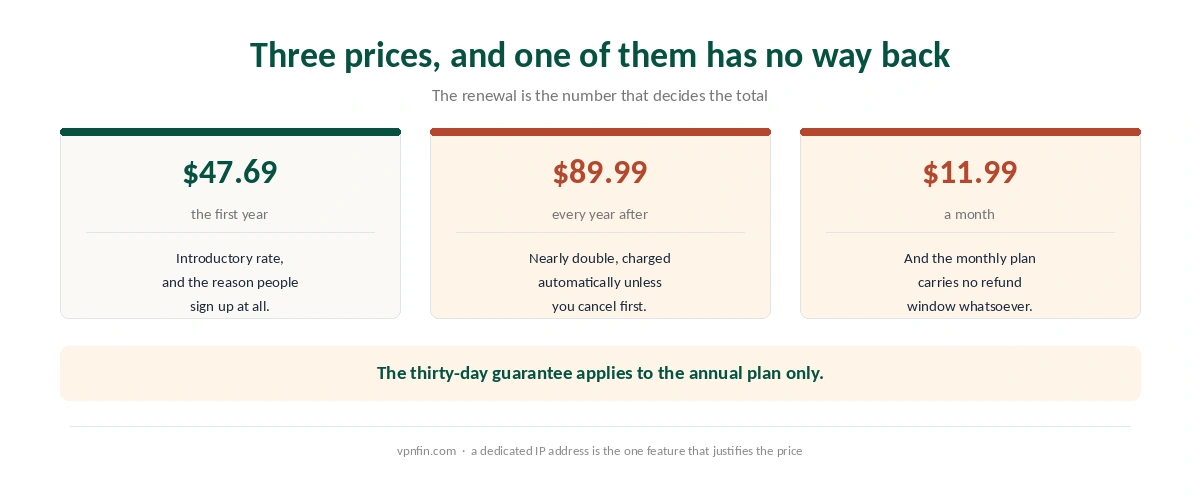
$47.69 for the first year, then $89.99 for every year after that — the renewal is close to double, and it is charged automatically.
$11.99 a month on the monthly plan, which carries no refund window at all.
⚠️ The thirty-day guarantee applies to the annual plan only. Buying monthly to test it cheaply leaves you with no way back — which is the trap our refund page describes, and it is unusually stark here.
Compare that with what else is available. Private Internet Access costs less, has three Deloitte audits and three federal demands answered with nothing — and our renewal table has the four-year picture.
Everything Else, Briefly
Protocols: WireGuard as the default, plus OpenVPN in both modes, IKEv2, IPsec, SSTP and L2TP. AES-256 throughout.
Network: reported figures disagree. Published reviews give 30 countries and 42 countries within the same year, and the company publishes less detail than most competitors.
Missing features: no multi-hop, no port forwarding, and split tunnelling on Android only.
Streaming works according to several independent reviews, though our main ranking treats access as a moving target at every provider.
The interface is the recurring complaint, described across reviews as outdated with unintuitive server selection.
Who It Is For
Take it if you specifically want a dedicated IP from a provider that owns its hardware, and you have twelve devices to cover.
Take the annual plan, never the monthly one. The monthly has no refund, and the annual at least lets you test.
⚠️ Look elsewhere if verification matters to you at all. Twenty years with no audit is not a gap that features close, and our privacy ranking excludes unaudited providers on principle.
How We Research
This review draws on Comparitech, Security.org, SafetyDetectives, Top10VPN and vpnMentor for the feature set, the absence of an audit and the missing leak protection, on Gizmodo for the pricing and the refund terms, and on CyberInsider, VPNpro, Tom’s Guide and PrivacyJournal for the ownership chain from Highwinds through StackPath to Ziff Davis. Server counts differ between sources published in the same year, so we have given the range rather than choosing. We note that Ziff Davis owns CNET, whose speed measurements we cite elsewhere on this site, and that Comparitech is owned by Point Wild, which sells VPNs of its own — we use both for mechanics and disclose the relationships rather than pretending they do not exist. We do not run our own tests. Our method lives on the About Us page.
StrongVPN FAQ
No. In more than twenty years of operation it has published no independent audit of its no-logs claim or its infrastructure, no transparency report and no warrant canary. The claim rests entirely on its privacy policy.
Ziff Davis, formerly j2 Global. The same company owns IPVanish, Encrypt.me and the WLVPN white-label platform, alongside publications including PCMag, CNET, Mashable, IGN and Speedtest.net.
Its encryption is standard and no logging scandal has ever been attached to it. Against that: a United States jurisdiction, no independent verification of any kind, and no protection against IPv6 or WebRTC leaks, which affects everyday use rather than hypothetical scenarios.
Reported figures are $47.69 for the first year and $89.99 for every year after, or $11.99 monthly. The thirty-day money-back guarantee applies to the annual plan only — the monthly plan carries no refund window at all.
Twelve simultaneous connections, which is two more than NordVPN or ExpressVPN permit and fewer than the providers offering unlimited devices.
StrongVPN
The Verdict
Twelve devices, WireGuard by default, torrenting allowed throughout, a dedicated IP option and its own server hardware rather than leased capacity. Against that: no independent audit in over twenty years, no transparency report, no warrant canary, no protection against IPv6 or WebRTC leaks, a United States jurisdiction, a renewal that nearly doubles, and no refund window on the monthly plan.
Final Verdict
StrongVPN owns its own machines, which very few providers do. That is a real answer to a real question about who controls the infrastructure your traffic crosses.
It has published nothing else in twenty years. No audit, no transparency report, no canary, and no protection against IPv6 or WebRTC leaks — from a company inside the Five Eyes arrangement.
And its parent owns the publications that review it. PCMag handled that better than it had to. We are disclosing it because we cite one of its sibling outlets ourselves, and you should be able to weigh that yourself.