
Disclosure: VPNFin is reader-supported. If you buy a VPN through links on this page, we may earn a commission at no extra cost to you. This never affects our ratings — here’s how we research.
Every review on this site measures providers by the same question: can you check the claim, or are you asked to trust it? Proton VPN publishes five annual audits. Mullvad publishes more than ten. Hotspot Shield publishes none.
That standard exists because a small Canadian company with a cartoon bear invented it. TunnelBear commissioned Cure53 to audit its apps, servers and backend in 2016, published the findings in full in 2017, and has repeated the exercise every year since. Nobody had done that before.
The service itself is modest, and this TunnelBear review covers where it falls short — including one omission that no other provider we cover shares.
Is TunnelBear Worth It in 2026?
For a beginner who wants something simple and verifiable, yes. Around $3.33 a month on a three-year plan, unlimited devices, and the longest unbroken audit record in the category.
The catches are real: streaming barely works, McAfee owns it, Canada sits inside Five Eyes, and there is no standard money-back guarantee — refunds are considered case by case.
TunnelBear at a Glance
Pros
- ✔ The longest unbroken public audit record of any VPN — Cure53, annually since 2017
- ✔ Every report published in full, findings included rather than summarised
- ✔ Unlimited simultaneous devices on every paid plan
- ✔ A free tier with 2 GB a month, no card required
- ✔ The most approachable interface in the category, by a distance
- ✔ GhostBear obfuscation for networks that block VPN traffic
Cons
- ✖ No standard money-back guarantee — refunds are decided case by case
- ✖ Owned by McAfee, a publicly traded US corporation, since March 2018
- ✖ Canada sits inside the Five Eyes arrangement
- ✖ Streaming is unreliable, and Netflix frequently does not work
- ✖ No port forwarding, no dedicated IP, no DNS-level ad blocking
- ✖ Around 47 countries, smaller than the mainstream networks
The Audit Nobody Else Was Doing
In 2016 the industry standard for proving a no-logs claim was writing it on the website.
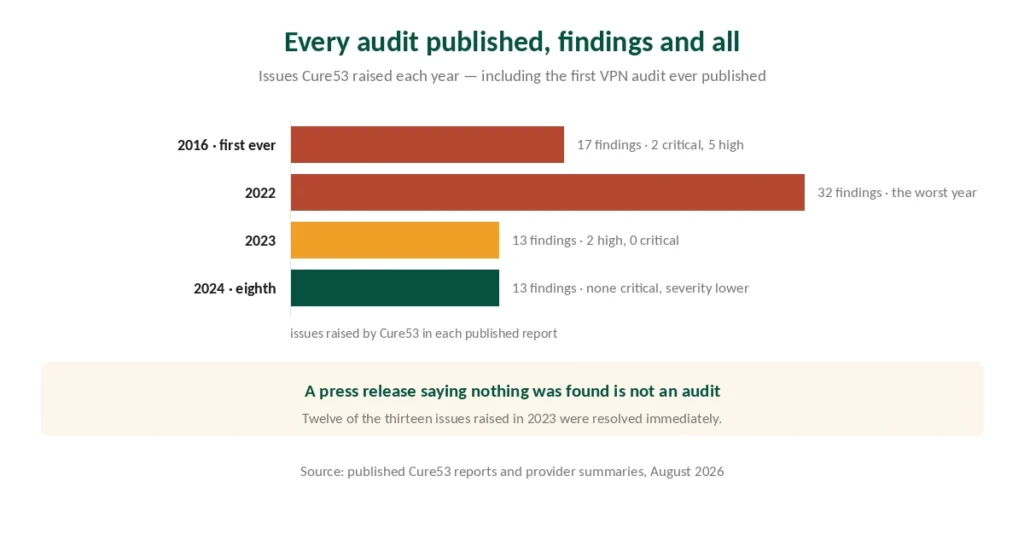
TunnelBear hired Cure53 and published the result. The first report examined the apps, the server infrastructure and the backend systems, and it did not flatter the company: the findings included two issues rated critical and five rated high, all subsequently fixed. Publishing that was the point.
Then it did it again the following year, and every year after. By 2024 the eighth annual audit was complete, with the ninth scheduled. No other provider has an unbroken run of that length.
The numbers show the practice working. Cure53 raised 32 issues in 2022 and 13 in 2023, of which two were high-risk and none critical. TunnelBear resolved twelve of the thirteen immediately. The 2024 round found ten issues of medium severity or above and three low. Auditors described a marked security improvement year over year.
⚠️ This is what an audit is supposed to look like. Not a press release announcing that a firm found nothing, but a document with problems in it, published anyway, followed by the next one.
Everyone measuring VPNs by audit count today is using a yardstick this company made. NordVPN’s Deloitte cadence, Proton’s annual Securitum reports and Mullvad’s ten-plus Cure53 engagements all came later — as did the 28 reports ExpressVPN now lists.
Then McAfee Bought It
March 2018, and this is where the recommendation gets complicated.
The team stayed in Toronto and kept its autonomy, by all published accounts, and the audit programme survived the acquisition intact — which is the strongest argument in its favour.
But the corporate parent is a publicly traded US security company. That brings obligations to shareholders, regulators and law enforcement that an independent operator does not carry. Canada is separately a member of the Five Eyes intelligence-sharing arrangement.
⚠️ Nothing has gone wrong. No breach, no logging incident, no reported disclosure in eight years. The concern is structural rather than historical, and how much weight it deserves depends entirely on who you are hiding from. Our legality guide covers how much jurisdiction decides in practice.
For comparison, the providers in our coverage with no parent company at all are Proton VPN, Mullvad and Windscribe.
The Refund Problem
This is the finding that surprised us, and it is the practical reason to hesitate.
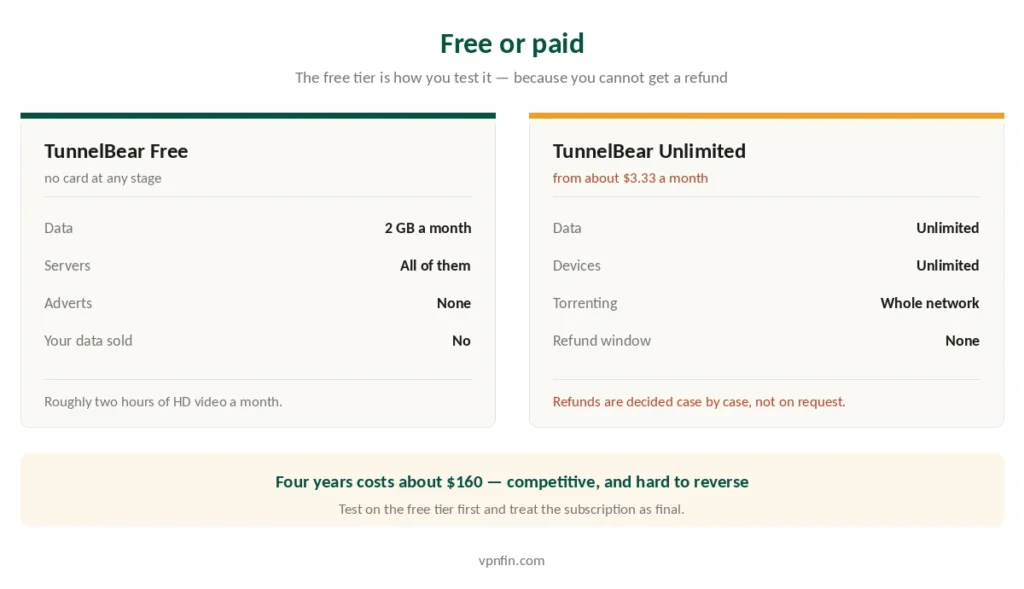
TunnelBear does not offer a standard money-back guarantee. Refunds are considered case by case rather than granted on request within a fixed window.
Almost every provider we cover gives you at least 30 days. CyberGhost and Hotspot Shield give 45, Norton VPN gives 60 on annual plans, and Windscribe gives three, Norton VPN gives 60 on annual plans. That window is not a nicety — it is how you find out whether a VPN works on your connection, with your streaming services, at your usual hours. Set against CyberGhost, where the four-year cost differs by eight dollars, it becomes the deciding factor.
⚠️ The free tier partly compensates. Two gigabytes a month with no card is enough to test whether the apps work and whether speeds are acceptable, which is more than a refund policy gives you upfront. It is not enough to test streaming or sustained use.
Practical advice: use the free tier first and treat the paid subscription as non-refundable. Our free trial guide covers what each provider’s conditions actually mean, and the cheapest provider we cover gives 31 days at twelve dollars less.
Price and Plans
Around $3.33 a month on the three-year plan, $4.00 on the annual, and $9.99 month to month. A Teams plan runs about $5.75 per user.
Every paid plan now includes unlimited simultaneous devices, changed from the previous cap of five. Many reviews still quote the old number. Surfshark is the other provider we cover that does this, which makes the two worth comparing on everything else.
Across four years that comes to roughly $160, which sits near CyberGhost’s $152 and below Proton VPN’s $240. Competitive, particularly given the audit record.
⚠️ Weigh that against the absent refund window. A cheap subscription you cannot return is not obviously better value than a dearer one you can.
The Free Tier
Two gigabytes a month, up from 500 megabytes, with no payment card at any stage and access to the full server list.
That is roughly two hours of HD video, or a few days of light browsing. It is an evaluation tier rather than a way to run a VPN indefinitely, and TunnelBear describes it that way.
What makes it unusual is what is absent. No advertising, no data cap traded for tracking, no location data sold for targeting — the arrangement Hotspot Shield discloses for its free users. Our free VPN guide covers which free tiers avoid that trade.
Speed, Streaming and Torrenting
Speeds are adequate rather than notable. WireGuard, OpenVPN and IKEv2 are supported, and throughput is sufficient for HD video on nearby servers. It does not approach NordVPN’s 2.9% average loss in CNET’s testing.
Streaming is the weakest area. Published testing reports Netflix failing on most servers, and TunnelBear maintains no streaming-optimised servers and no Smart DNS. If regional catalogues are the reason you are buying, our streaming guide points elsewhere.
Torrenting changed recently. P2P is now permitted across the whole network rather than on designated servers, with the best performance in Canada, the United States, the United Kingdom, Romania, the Netherlands, Germany and Sweden. There is no port forwarding, which matters for seeding on private trackers, as our torrenting guide explains.
Roughly 47 countries — smaller than mainstream networks, adequate for common destinations.
What We Don’t Love
No refund window is the real problem, and it is strange for a company otherwise defined by treating customers straightforwardly.
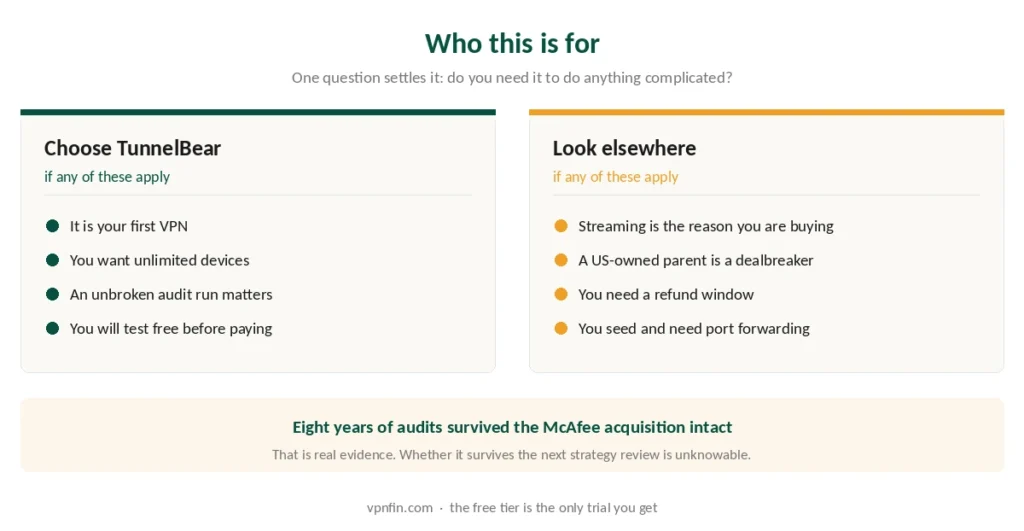
The McAfee question will not resolve itself. The audit programme has survived eight years of corporate ownership, which is genuine evidence. Whether it survives the next strategy review is unknowable.
Streaming is not merely weak but largely absent. That is a legitimate product decision, though it removes a common reason for buying a VPN at all.
Our score of 4.0 sits below PureVPN’s 4.1, which is uncomfortable given one of them invented published auditing and the other was caught handing over connection records. Our five criteria weigh streaming and features equally with verification, and this is where that shows.
How We Research
This review draws on the published Cure53 audit reports and TunnelBear’s own summaries of them, contemporaneous reporting on the March 2018 McAfee acquisition, published testing of streaming access from named reviewers, and pricing and plan terms from multiple sources compared against each other — cross-checked and verified at publication. We don’t run our own speed tests. Where reviews carried figures that TunnelBear has since changed, notably the free data allowance and the device limit, we use the current numbers and say which ones are stale. Our full approach lives on the About Us page.
TunnelBear FAQ
It was the first major commercial VPN to commission a public third-party audit and publish the results. Cure53 conducted the work in 2016 and the report appeared in 2017, covering apps, servers and backend systems. The practice has been repeated annually ever since, and the rest of the industry adopted it afterwards.
Not through a standard guarantee. TunnelBear considers refund requests case by case rather than offering a fixed window, which sets it apart from every other provider we cover. Use the free tier to evaluate the service first, and treat a paid subscription as difficult to reverse.
It depends who you are protecting yourself from. McAfee acquired TunnelBear in March 2018 and the audit programme continued unchanged, which is real evidence. The concern is structural: a publicly traded US parent carries obligations an independent company does not, and Canada sits inside the Five Eyes arrangement.
For evaluation, yes. It gives 2 GB a month with no payment card and full server access, up from 500 MB previously. That covers roughly two hours of HD video or several days of light browsing. It is not advertising-supported and does not trade your location data.
Usually not. Published testing reports Netflix failing on most TunnelBear servers, and the company maintains no streaming-optimised servers and no Smart DNS. Torrenting, by contrast, is now permitted across the whole network rather than on designated servers.
TunnelBear
The Verdict
The longest unbroken public audit record of any VPN, published annually since 2017 with the findings intact. The costs are McAfee ownership, unreliable streaming, and no standard money-back guarantee.
Final Verdict: 4.0/5
Buy it if you want something simple that has been checked every year since 2017. The interface is the friendliest in the category, devices are unlimited, and the audit record is the longest anyone has.
Skip it if streaming matters, if a US-owned parent is a dealbreaker, or if you need to be able to get your money back.
And give the company its due. The practice we use to judge every provider on this site — hire an outside firm, publish what they find, do it again next year — was started by TunnelBear when nobody was asking for it.