
Disclosure: VPNFin is reader-supported. If you buy a VPN through links on this page, we may earn a commission at no extra cost to you. This never affects our ratings — here’s our full disclosure.
Yes, in roughly 95% of the world. VPNs are legal across the United States, Canada, the entire European Union, the United Kingdom, Australia, Japan, Brazil, South Africa and most of Latin America and Southeast Asia. The question only gets complicated in about a dozen countries — and there the answer is rarely a simple ban.
This is not legal advice. We report what published sources say about VPN law as of August 2026. Laws change without notice, enforcement varies with political conditions, and if you need certainty about your own situation, ask a lawyer in your jurisdiction rather than a website.
The Short Answer
Legal almost everywhere. No country in Western Europe, North America or Oceania restricts personal VPN use. Japan is among the clearest cases — no restricting laws and strong internet freedom protections. Brazil is the exception worth knowing — legal generally, but a court fined VPN users during a 2024 platform block.
Two countries ban them outright for ordinary citizens: North Korea and Turkmenistan.
Around a dozen restrict them to government-approved providers or block them at network level — China, Russia, Iran, Belarus, Oman, Myanmar, Iraq and the UAE appear on most lists.
And everywhere on earth, a VPN does not make illegal activity legal.
Why “Legal or Illegal” Is the Wrong Question
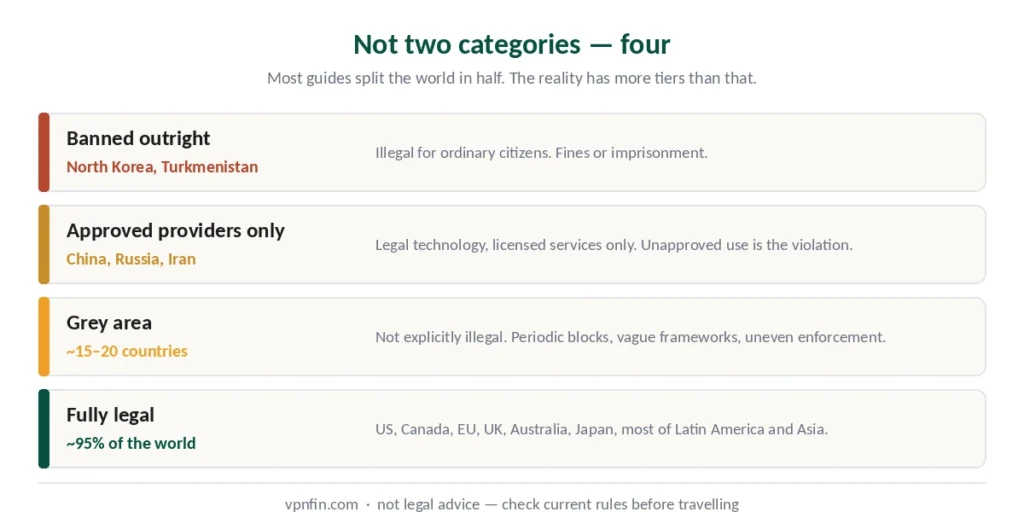
Most guides split the world in two. The reality has four tiers, and the difference between them matters if you travel.
Tier 1 — Banned outright. VPN use is illegal for ordinary citizens, with fines or imprisonment attached. North Korea and Turkmenistan are the clear cases; in North Korea most citizens only have access to a state-controlled intranet rather than the internet at all. South Korea is the opposite case on the same peninsula: fully legal, heavily filtered.
Tier 2 — Restricted to approved providers. The technology is legal, but only through government-licensed services that comply with state filtering. China, Russia and Iran are the standard examples — and China is the case where the rules also name the individual, not only the company. Using an unapproved provider is the violation, not using a VPN. Indonesia is the awkward case — no criminal prohibition, but licensing demands raised since 2019 and no clear enforcement.
Tier 3 — Grey area. Not explicitly illegal, but subject to periodic blocks, vague legal frameworks or penalties tied to what you access rather than the connection itself. Roughly 15–20 countries sit here, including Pakistan, Vietnam, Saudi Arabia, Egypt and Uganda. Turkey is the clearest example: legal to use, yet 27+ services blocked at brand level, because the law there obliges providers rather than users.
Everywhere else — fully legal, which is the vast majority of the world. India sits here nationally and in tier 3 locally, which is a distinction no single tier captures well. Australia illustrates the nuance: fully legal, yet with two years of mandatory metadata retention behind it.
The Detail Nobody Mentions
In several countries that restrict personal VPN use, corporate VPNs remain entirely legal. China and Russia both permit businesses to run them.
That is the clearest evidence of what these rules are actually about. If VPN technology were inherently dangerous, it would be banned for companies too. Instead, the same governments that restrict individual privacy license the identical technology for commercial use.
The restriction targets who gets privacy, not what the technology does.
Where the Sources Disagree
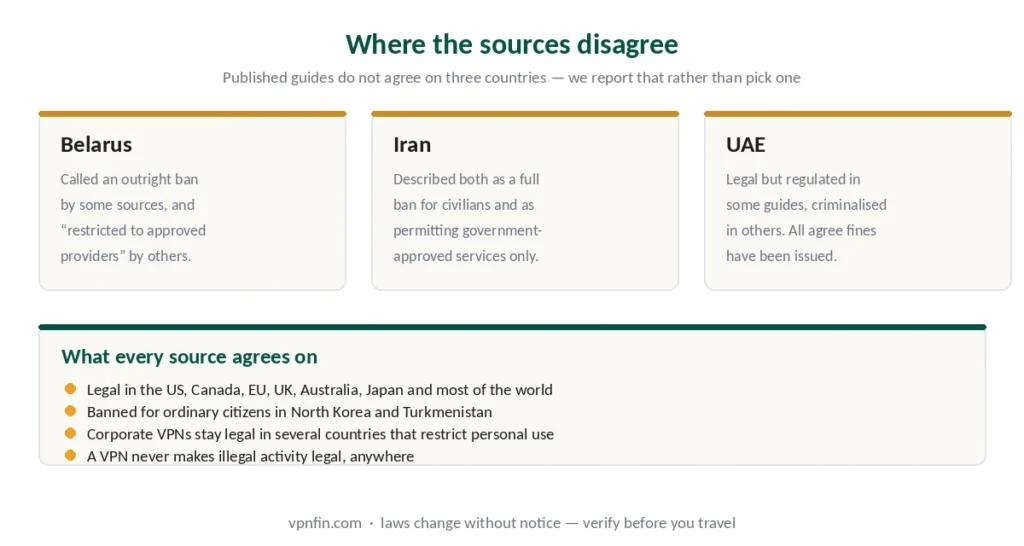
We compared several published guides and found genuine inconsistency on specific countries. Rather than pick one and sound confident, here is where the disagreement sits.
Belarus appears as an outright ban in some sources and as “restricted to approved providers” in others.
Iran is described both as a full ban for civilians and as permitting only government-approved services.
The UAE is the messiest. Some sources call it legal but regulated; others report that unauthorised use has been criminalised. The statute itself never mentions VPNs — what Article 10 actually requires is a two-part test, and the second part is the one most guides drop.
Practical implication: if you are travelling to any country in tiers 1 to 3, do not rely on a review site — including this one. Check your own government’s travel advisory and the destination’s current regulations before you go.
What a VPN Never Makes Legal
This part is not ambiguous anywhere.
A VPN encrypts your traffic and masks your IP address. It does not change what is lawful in your jurisdiction. It also does less than the advertising implies in several other ways — what it actually does, and what it never claimed to. Copyright infringement, fraud, harassment and every other offence remain offences whether or not the connection is encrypted.
Nor does a VPN make you invisible to law enforcement. Providers can be compelled to disclose whatever data they hold — which is exactly why audited no-logs policies matter, and why we cover audit records in detail in every review we publish.
One common grey area worth naming: watching another country’s streaming library breaches the platform’s terms of service, not the law. The realistic consequence is that the platform blocks the server you are using, not legal action. YouTube TV is the strictest example — the realistic consequence there is playback errors rather than anything worse.
Regional pricing is the sharper version — the platform can reprice or suspend the account, not just block a stream.
If You’re Travelling to a Restricted Country
Practical logistics rather than legal advice.
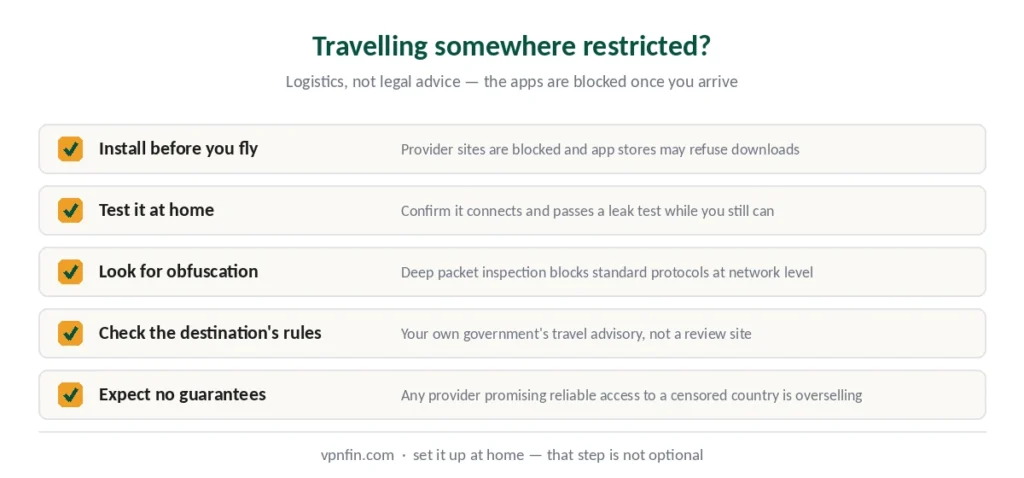
Install before you fly. In China, Russia, Iran and the UAE, VPN provider websites are blocked, and app stores may restrict downloads when accessed from those countries. Arriving without the app already installed means you probably cannot get it.
Test it at home first — confirm it connects and passes a leak test before you travel. Five tests cover it, and the DNS one catches the most problems.
Understand what obfuscation does. Several countries deploy deep packet inspection, which identifies and blocks standard VPN protocols at network level. Providers respond with obfuscated servers that disguise VPN traffic as ordinary HTTPS. ExpressVPN has the strongest reported record here; NordVPN also offers obfuscated servers. Tor faces the same restrictions in those countries, and for the same reasons.
Know that no provider guarantees access. Anyone promising reliable connectivity in a heavily censored country is overselling. What works this month may not work next.
What Changed Recently
Two trends worth knowing.
Data retention requirements are spreading. India’s 2022 rules requiring VPN providers to log user data prompted several major providers to remove physical servers from the country rather than comply — they now serve Indian users through virtual locations hosted elsewhere. The full story is here, including a second directive that arrived in April 2026.
And national permission does not always survive at district level. VPN use remains lawful across India, yet magistrates in several Jammu and Kashmir districts have prohibited it under a general public-order power since May 2025, with detentions reported — what the rules require, and of whom.
Democratic countries have floated restrictions and mostly backed off. Legislative attempts in the UK, France and parts of the US drew significant public and digital-rights opposition, and several were withdrawn. The direction of travel is contested rather than settled.
And a court can suspend permission without changing any law. Brazil restricts nothing by statute, yet in 2024 a single judicial order attached a daily fine to VPN use for thirty-nine days — what happened, and what survived the order.
How We Research
This guide draws on published legal summaries from named sources including Security.org, provider documentation, and country-by-country guides — cross-checked against one another, with disagreements reported rather than resolved by preference. We are not lawyers and this is not legal advice; where sources conflicted, as they did on Belarus, Iran and the UAE, we say so and recommend checking primary sources. Our full approach lives on the About Us page.
VPN Legality FAQ
Yes. There is no federal or state law restricting personal VPN use, and government agencies have recommended VPNs for privacy on public Wi-Fi. Illegal activity remains illegal whether or not you use one — the VPN does not change that.
North Korea and Turkmenistan are the clearest cases, where VPN use is illegal for ordinary citizens. In North Korea most people have access only to a state-controlled intranet rather than the wider internet. Sources disagree on whether Belarus belongs in this category or the next one.
China, Russia, Iran, Oman, Myanmar, Iraq and the UAE are the names that appear on most published lists. The common pattern is that only government-approved providers are permitted, with unapproved services blocked at network level. Corporate VPNs often remain legal in the same countries.
Not legally. Accessing a different regional library breaches the streaming platform’s terms of service, not the law. The realistic consequence is the platform blocking the server you connect through, which is why unblocking reliability varies month to month.
No, and no provider claims otherwise. A VPN encrypts your connection and hides your IP address from the sites you visit and the network you are on. Everything that is illegal without a VPN remains illegal with one, and providers can be compelled to disclose whatever data they hold.
India and Turkey are the clearest examples. India requires providers with local servers to retain subscriber data for five years; Turkey obliges internet companies to block VPN services rather than penalising the people using them. In both, the duty sits with the company rather than the subscriber.
The Short Version
In the United States, Canada, the UK, the EU, Australia and most of the world, using a VPN is unambiguously legal and requires no justification.
In about a dozen countries it is restricted, banned, or legally ambiguous — and in several of those, corporate use is permitted while personal use is not.
Everywhere: a VPN protects your privacy from your ISP and from the networks you connect to. It does not change what is legal, and it does not put you beyond the reach of law enforcement. Those are two different things, and most confusion about VPN legality comes from conflating them.