
Disclosure: VPNFin is reader-supported. If you buy a VPN through links on this page, we may earn a commission at no extra cost to you. This never affects our ratings — here’s our full disclosure.
The name is short for Torrent Guard. Since March 2022 the service has blocked BitTorrent traffic on every one of its servers in the United States.
That sentence is the whole review, and it is also misleading on its own. What the company gave up matters less than what it refused to give up, and almost no coverage separates the two.
Is TorGuard Any Good?
For a specific technical user, yes. Port forwarding, dedicated IP addresses, obfuscation that reportedly works on restrictive networks, and a bootstrapped owner with no investors — rare in a market where two groups own most of the brands.
For torrenting in the United States, no. The feature is blocked there by court settlement, and no setting restores it.
⚠️ And it has never been independently audited. Zero no-logs reports in over a decade, from a company based in Florida, inside the Five Eyes arrangement.
What Actually Happened
The case is worth setting out properly, because the summaries flatten it.
In October 2021 roughly twenty-five film studios sued. They alleged the company’s marketing encouraged infringement and that it profited from it.
The evidence came through the datacentre. The studios said they had sent about 97,640 infringement notices to QuadraNet, the hosting provider, covering addresses assigned to TorGuard — and that QuadraNet neither acted on them nor forwarded them.
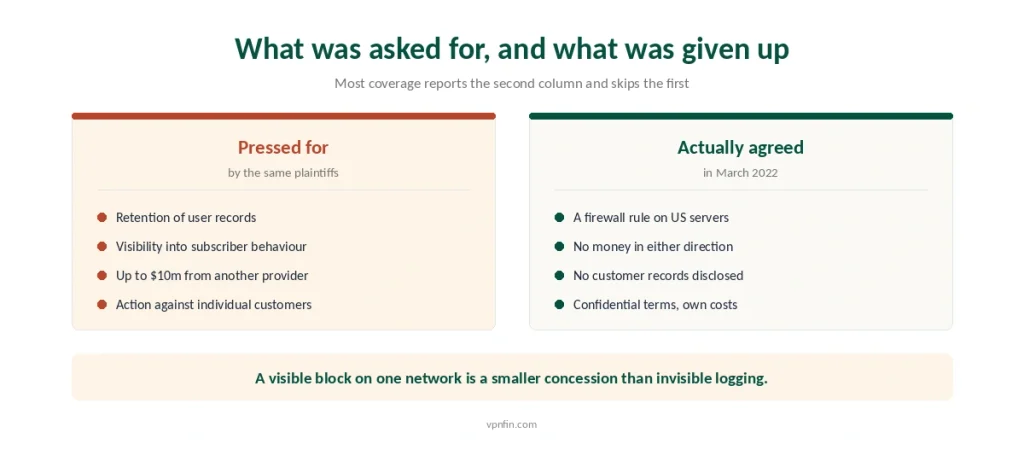
In March 2022 the parties settled. TorGuard agreed to use commercially reasonable efforts to block BitTorrent traffic on its United States servers using firewall technology.
No money changed hands. Both sides agreed to cover their own costs, and the terms of the agreement itself remained confidential.
⚠️ The studios had been asking for logging. In parallel actions the same plaintiffs sought damages of up to $10 million from LiquidVPN and pressed providers to retain records of user behaviour. TorGuard gave up a protocol on one network instead, and disclosed no customer records throughout.
The Trade Nobody Describes
Here is the part that decides how you should read this.
A logging requirement would have been permanent and invisible — the thing a VPN is supposed to remove, reinstated by court order. It would apply everywhere, to every customer, and you would have no way to detect it.
A protocol block is neither. It applies to one country’s servers, it is visible the moment you try, and it does not touch anybody’s records.
⚠️ That is a defensible trade and it should be named as one, rather than reported as a company abandoning its principles. What a no-logs policy is actually worth depends entirely on what a provider does when someone with lawyers arrives.
It also was not a precedent. A settlement binds the parties to it, and the same group reached similar agreements with VPN.ht and VPN Unlimited. The pattern is industry pressure rather than case law.
The Collateral Damage
A detail worth its own section, because it is the strongest argument against the settlement.
BitTorrent is not only used for piracy. Software distribution uses it, including update delivery by large platforms, and a firewall that blocks the protocol blocks those too.
A blanket block cannot distinguish between them. Filtering by protocol removes legitimate traffic along with the rest, which is the same structural problem Spanish football blocking creates by filtering addresses.
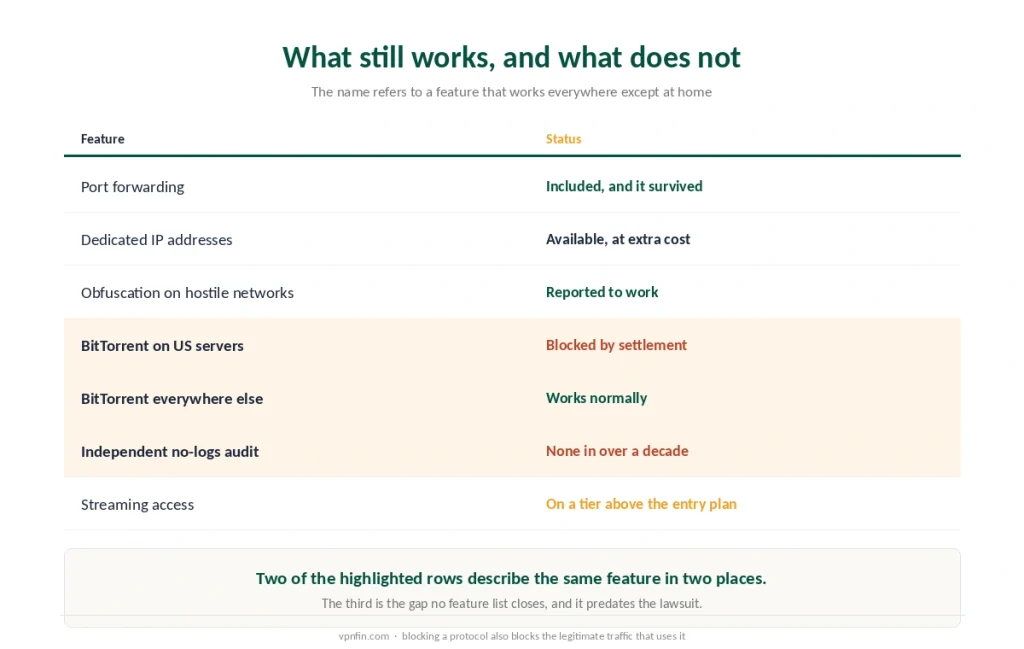
⚠️ Only United States servers are affected. Connect through another country and BitTorrent works normally, which is a genuine mitigation and one the company states plainly.
The Gap It Never Closed
The settlement is not the weakest thing here.
No independent no-logs audit exists, after more than a decade of operation. Mullvad publishes them annually and PIA answered two federal subpoenas with nothing. TorGuard has a lawsuit it settled and its own word.
It operates from Florida, and the United States sits inside the Five Eyes arrangement with no mandatory retention but no shortage of legal process either.
The clients are closed source.
⚠️ The no-logs claim did survive litigation, which is more than most providers can say, and it is the reason the score below is not lower.
| Provider | No-logs audits | Auditor | Jurisdiction |
|---|---|---|---|
| NordVPN | 6 | PwC, Deloitte | Panama |
| Surfshark | 2 | Deloitte | Netherlands (9 Eyes) |
| ExpressVPN | 3 | KPMG | British Virgin Islands, Kape-owned |
| CyberGhost | 3 | Deloitte | Romania, Kape-owned |
| PureVPN | 4 | KPMG | BVI, operated from Pakistan |
| IPVanish | 2 | Leviathan, Schellman | United States (Five Eyes), Ziff Davis-owned |
| Windscribe | 1 | Packetlabs, production infrastructure | Canada (Five Eyes); Greek case dismissed, no data to give |
| Proton VPN | 5 | Securitum | Switzerland, moving infrastructure to EU |
| Private Internet Access | 3 | Deloitte | United States (Five Eyes), Kape-owned |
| Mullvad | 10+ | Cure53, Assured AB | Sweden (14 Eyes) |
| TunnelBear | Annual since 2017 | Cure53 | Canada (Five Eyes), US parent |
| Norton VPN | 2 | VerSprite | United States (Five Eyes) |
| Hotspot Shield | 0 | protocol audited, policy not | United States (Five Eyes) |
| AirVPN | 0 | none — the client is open source instead | Italy (14 Eyes) |
| IVPN | 8, annual since inception | Cure53 | Gibraltar (status disputed) |
| Hide.me | 1 modern, in 2024 | Securitum, though one source names Altius IT | Malaysia (outside the alliances) |
| PrivadoVPN | 0 | none in six years of operation | Iceland (moved from Switzerland, 2026) |
| TorGuard | 0 | none; settled a lawsuit without disclosing records | United States (Five Eyes) |
| FastestVPN | 1, in 2023 | Altius IT | Cayman Islands (outside the alliances) |
| StrongVPN | 0 | none in over two decades | United States (Five Eyes), Ziff Davis-owned |
| VyprVPN | 1, in 2018 | Leviathan Security, before the 2023 sale | United States (Five Eyes), Certida-owned since 2023 |
| PrivateVPN | 0 | none; support says there is nothing to audit | Sweden (14 Eyes), ownership disputed |
| ZoogVPN | 0 | none; support describes one as planned | Greece (outside the alliances), run from Ukraine |
What It Costs
Pricing is the most complicated we have documented. Reported figures run from about $4.27 to $10.99 a month on the Standard plan, with tiers above it.
Streaming access sits on a higher tier. The entry plan covers the VPN and not the unblocking, which is unusual and easy to miss at checkout.
Dedicated IP addresses cost extra, and they are the reason many of its users are there.
Everything Else
Around 3,000 servers, which is mid-sized rather than large.
Port forwarding is included, and it survives — our torrenting guide explains why that matters more than raw server counts for seeding.
Obfuscation is a strength. Stealth modes are reported to work on networks that block VPN traffic outright — the situation several countries have created deliberately.
The interface is the recurring complaint across reviews: powerful, and not designed for someone opening it for the first time.
Private Internet Access answered three federal demands with nothing, and did not have to change its product — both were tested, neither gave anything up.
The Other Lawsuit
Brief, because it ended without a ruling and is often quoted as though it did not.
In 2019 TorGuard sued NordVPN, alleging orchestrated attacks and an attempt to force the removal of critical video reviews.
NordVPN’s account differs entirely. It said it had found TorGuard server configuration files publicly accessible and disclosed the problem without conditions.
⚠️ The case was dismissed on jurisdictional grounds, so nothing was decided on the merits. Both accounts remain claims, and we are not adjudicating between them.
Who It Is For
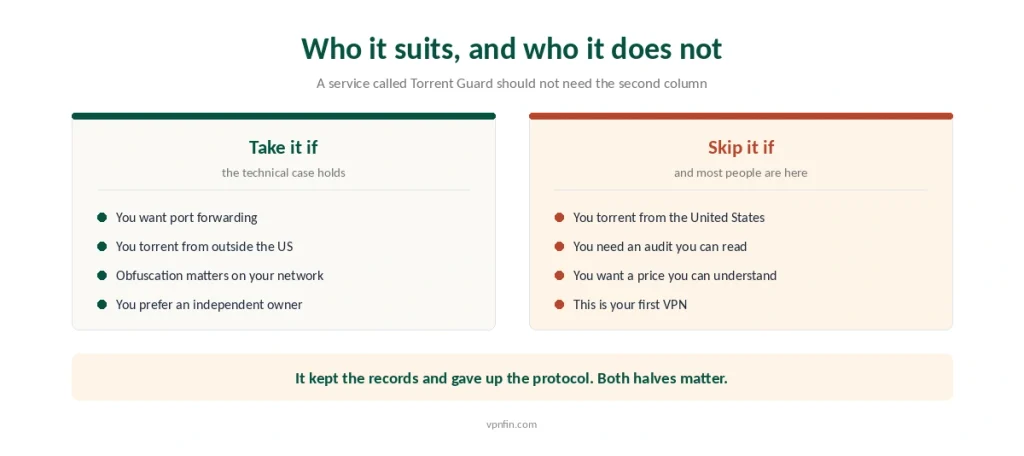
Take it if you want port forwarding, dedicated IPs and obfuscation, and you torrent from outside the United States or not at all.
Do not take it for torrenting from the United States, which is the sentence a service called Torrent Guard should never require.
Look elsewhere if verification matters. No audit in over a decade is the gap that no feature list closes — AirVPN has the same gap and answers it differently, with open-source clients.
How We Research
This review draws on TorrentFreak and BleepingComputer for the March 2022 settlement text and the confirmation that no money changed hands, on Techdirt for the parallel settlements reached by VPN.ht and VPN Unlimited and the earlier $10 million demand against LiquidVPN, on VPNOverview for the figure of roughly 97,640 infringement notices sent to QuadraNet and the dismissal of the earlier action against that company, on TechRadar for the studios’ October 2021 filing, and on vpn.social and VPNTesting for the corporate structure, the pricing tiers, the absence of any independent audit and the 2019 dispute with NordVPN. Where the two companies’ accounts of that dispute conflict, we have presented both rather than choosing. We do not run our own tests. Our method lives on the About Us page.
TorGuard FAQ
Not on its United States servers. A March 2022 settlement with film studios required it to block BitTorrent traffic there using firewall technology. Servers in other countries are unaffected, and the company states that plainly rather than burying it.
Roughly twenty-five film studios sued in October 2021, alleging its marketing encouraged infringement. The evidence centred on about 97,640 notices sent to its datacentre provider, which neither acted on them nor forwarded them. The case settled in March 2022 with no money changing hands.
No published account describes it doing so. The studios in these cases have generally pressed providers to retain records of user behaviour; TorGuard’s settlement concerned traffic filtering instead, and it disclosed no customer records during the litigation.
No. In more than a decade of operation it has published no independent no-logs audit. The privacy case rests on the written policy and on its conduct during the lawsuit, which is more evidence than most unaudited providers can offer and less than an audit would give.
VPNetworks LLC, based in Orlando, Florida, founded by Benjamin Van Pelt. It is bootstrapped, with no outside investors and no parent company — unusual in a market where most large brands belong to one of two groups.
TorGuard
Summary
Port forwarding, dedicated IPs, obfuscation that works on restrictive networks, and an independent bootstrapped owner. Against that: BitTorrent blocked on US servers by settlement, no independent audit in over a decade, a Five Eyes jurisdiction, complicated tiered pricing and an interface reviewers consistently criticise.
Final Verdict
TorGuard gave up the function it is named after, on the servers where it was sued. That is as awkward as it sounds, and it is only half the story.
It did not give up customer records, which is what the plaintiffs in these cases have generally been after. A visible block on one country’s servers is a smaller concession than an invisible logging requirement everywhere.
What it has never done is prove any of it. More than a decade of operation and not one independent audit, from a company inside the Five Eyes arrangement — which is the reason to look at it carefully rather than the settlement.