
Disclosure: VPNFin is reader-supported. If you buy a VPN through links on this page, we may earn a commission at no extra cost to you. This never affects our ratings — here’s how we research.
PureVPN is the only provider in this category that lets its auditor arrive unannounced. It is also the only provider in our top five that once handed connection logs to the FBI while marketing itself as a no-logs service. This PureVPN review covers both facts, because you cannot evaluate the first without the second. What follows is the 2017 case in detail, the four KPMG audits that came after it, the $47.95 renewal price, and speed results that vary by a factor of seven between testing labs.
Is PureVPN Worth It in 2026?
Yes for budget streaming, with one condition: you have to be comfortable with the 2017 history. PureVPN now runs the industry’s most aggressive audit programme, covers 10 devices, and costs around $2.15 a month on the two-year plan. Renewal is $47.95 a year. If the past disqualifies it for you, that is a defensible position — and this review will not argue you out of it.
PureVPN at a Glance
Pros
- ✔ Always-on audit: KPMG may inspect the infrastructure unannounced, at any time
- ✔ Four KPMG no-logs audits on public record, plus an earlier Altius IT audit in 2019
- ✔ 10 simultaneous devices, expandable to 50 through a paid add-on
- ✔ Around $2.15 a month on the two-year plan — among the lowest in the category
- ✔ 31-day money-back guarantee on every plan
- ✔ Port forwarding (paid add-on) and multi-hop, both absent from several pricier rivals
Cons
- ✖ Handed connection logs to the FBI in 2017 while marketing a no-logs policy
- ✖ Registered in the British Virgin Islands, but operated from Pakistan
- ✖ Speed results vary wildly between independent labs — one measured 12% retention
- ✖ Renewal roughly doubles the promotional rate, to $47.95 a year
Security & Privacy: The 2017 Case, and What Came After
This section comes before the speed and streaming sections because it is the reason most people are reading this review.
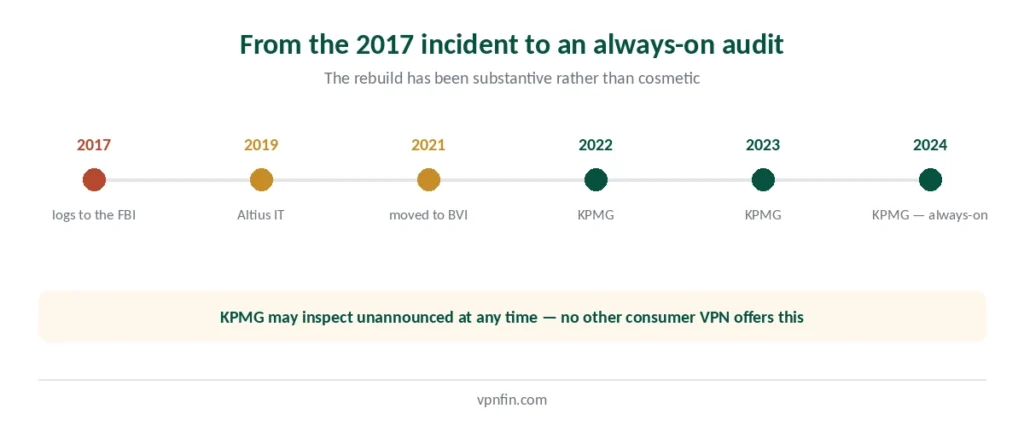
What happened. In October 2017, PureVPN supplied connection logs to the FBI in a cyberstalking investigation. The logs contained connection timestamps that linked a suspect’s real home IP address to the VPN IP addresses used in the harassment campaign, and they contributed to a conviction. The problem was not the cooperation — it was that PureVPN was marketing itself as a no-logs provider at the time. It had logs to hand over because it was keeping them. The case became the canonical example of a no-logs claim collapsing under legal scrutiny, and the criticism that followed was justified.
What changed. The rebuild has been substantive rather than cosmetic. Altius IT audited the systems in 2019 and found no logs capable of identifying users. KPMG has since conducted four no-logs audits, the most recent completed in April 2024, confirming that PureVPN retains no connection logs, no originating IP logs, no DNS queries, and no browsing activity. In 2021 the parent company relocated from Hong Kong to the British Virgin Islands.
PureVPN is one of two providers in our catalogue that failed an unscheduled test. That page sets the 2017 disclosure beside the cases where police warrants and subpoenas produced nothing, and explains why connection logs are the category that matters.
Set against Private Internet Access, the question becomes sharper. One of the two handed over connection records; the other answered two federal subpoenas with nothing, and both cost about the same.
The Always-On Audit
The part that genuinely stands out. PureVPN’s arrangement with KPMG is an always-on audit: the auditor may conduct unannounced inspections of the infrastructure at any time. This removes the preparation window that every scheduled audit allows. As far as we can establish, no other consumer VPN maintains continuous third-party verification of this kind — NordVPN’s six audits and ExpressVPN’s 28 are all scheduled engagements. It is a meaningful answer to the specific failure of 2017, and it stands out most against a provider that has never been examined at all.
The gap that remains. The British Virgin Islands sits outside the 5, 9, and 14 Eyes arrangements with no mandatory data retention, and that is a real advantage. But parent company GZ Systems, trading as Gaditek, runs its operations from Pakistan — a jurisdiction with weak data protection law and broad state surveillance powers. Registration and operation are not the same thing, and most reviews mention only the first. Compared against Proton VPN, that distinction cuts both ways. Proton VPN is currently separating the two deliberately, moving its infrastructure out of Switzerland while keeping its Geneva address. Worth knowing separately: PureVPN absorbed Ivacy VPN in 2024 after years of denying the two were connected, so the second brand is no longer an alternative to the first.
Encryption is AES-256-GCM on OpenVPN and ChaCha20-Poly1305 on WireGuard. A kill switch, split tunneling and multi-hop across 40+ country combinations are included; port forwarding is a separate add-on at $0.99 a month.
A cheaper provider with a single audit makes the contrast clearer — FastestVPN against PureVPN.
Speed & Performance
Independent speed results for PureVPN disagree more sharply than for any other provider we have reviewed, and that disagreement is itself the finding.
One tester on a 945 Mbps fibre line measured 65% retention on same-country WireGuard routes, against 83% for NordVPN in the same round. A second recorded 67% retention on average, noting that Windows lost 11% upload while Mac lost 48%. A third, testing on a 500 Mbps connection, got 59 Mbps from a US server — under 12% of baseline — with a Canadian server at 39 Mbps and a London server at 18 Mbps. A fourth measured a global average of roughly 163 Mbps.
Two of those results describe a competent mid-tier VPN. One describes a service that barely functions. All four are from testers who publish their methodology.
The most likely explanation is server-level inconsistency rather than measurement error: PureVPN’s network appears to vary sharply by node and by time of day in a way that better-provisioned networks do not. The practical implication is specific — if you buy PureVPN and your first server is slow, try three more before concluding anything. That advice is unnecessary with the providers ranked above it here.
Multi-hop testing produced a predictable result: a UK-to-Switzerland route dropped from 612 to 145 Mbps, which is normal for double-routed traffic, with stable connections throughout.
Streaming & Torrenting
Streaming is where PureVPN earns its ranking. Over 30 days of testing across 12 servers, one reviewer reliably unblocked Netflix libraries in the US, UK, Japan, Canada, and Germany, with Disney+, BBC iPlayer, Prime Video, and HBO Max also working consistently. Two temporary failures resolved on a server change. Hotstar and some ITVX servers were the weak points.
Access shifts month to month across this whole industry, so use the 31-day refund window to test the specific libraries you care about rather than trusting any review’s snapshot.
Torrenting is supported on designated servers, and PureVPN sells port forwarding as an add-on at $0.99 a month — a feature CyberGhost and ExpressVPN omit at any price, and one that materially affects seeding ratios. PIA includes it in the base price for about the same money. For users who care about that, it is a genuine reason to choose PureVPN over pricier competitors — our torrenting guide explains who actually needs it and who doesn’t.
Features and Device Limits
PureVPN runs 6,000+ servers across 80+ locations and covers 10 simultaneous devices on every plan, matching NordVPN and ExpressVPN’s entry tier. A paid Multi Login add-on extends that to 20, 30, 40, or 50 — the only provider in our top five offering a paid path past its own limit.
Beyond the basics, the feature list is deeper than the price suggests: port forwarding, multi-hop across 40+ country pairs, split tunneling, obfuscation marketed as Quantum-Resistant mode, and a dedicated IP add-on. One tester found obfuscation connected 6 times out of 10 from a restrictive corporate network, against 1 in 10 for standard WireGuard — better than nothing, behind ExpressVPN’s 9 in 10.
Apps and Known Complaints
The apps cover Windows, macOS, iOS, Android, Linux, browsers, Fire TV, and Android TV. Two consistent complaints from reviewers: in-app upsell promotions clutter the interface, and the Windows app has been reported crashing during extended testing. Worth running the four verification tests after any crash, since a reconnect can drop protections.
Pricing: Cheap Now, Double Later
The two-year Standard plan runs about $2.15 a month, billed upfront. Twelve months costs around $38.95 and month-to-month runs $10.95 to $12.95 depending on tier and current promotion. PureVPN discounts aggressively and often, so the figure you see will likely differ from any published in a review.
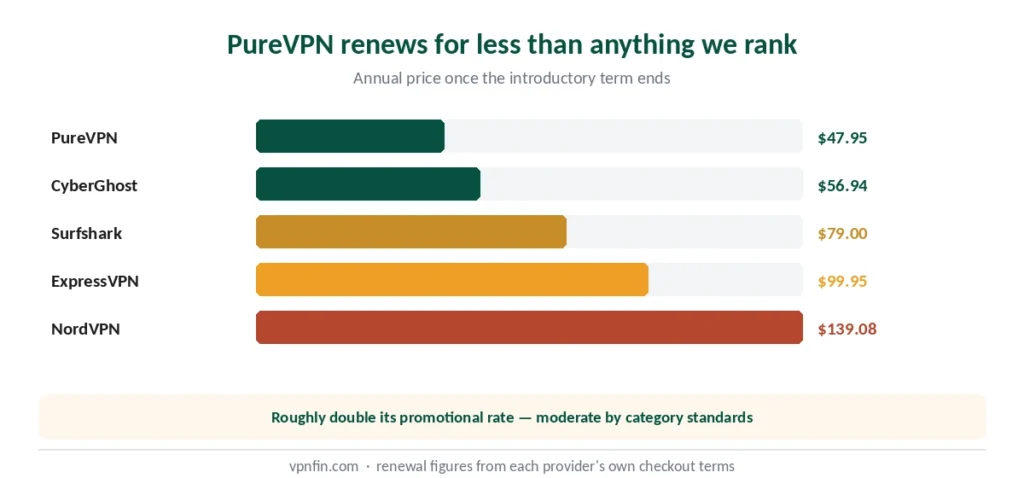
Renewal is the number to note. After the initial term, Standard renews at $47.95 a year — roughly $4.00 a month, close to double the promotional rate. In the context of this category that is moderate: Surfshark renews near $79 and ExpressVPN at $99.95. It also beats gambling on a lifetime deal from a company that may not outlast the promise. PureVPN’s support has stated publicly that website pricing is introductory and users are notified when their subscription expires. Across four years that still makes PureVPN the cheapest provider we rank — the full maths is here.
| Provider | Renewal price | Per month | Tier |
|---|---|---|---|
| NordVPN | $139.08/yr | ~$11.59 | Basic |
| Surfshark | ~$79/yr | ~$6.58 | Starter |
| ExpressVPN | $99.95/yr | ~$8.33 | Basic |
| CyberGhost | $56.94/yr | ~$4.75 | 2-year |
| PureVPN | $47.95/yr | ~$4.00 | Standard |
| IPVanish | $89.99/yr | ~$7.50 | Essential |
| Windscribe | ~$69/yr | ~$5.75 | Pro |
| Proton VPN | ~$83.88/yr | ~$6.99 | VPN Plus |
| Mullvad | ~$65/yr | ~$5.40 | flat, no tiers |
| Norton VPN | $79.99/yr | ~$6.67 | Standard |
| Hotspot Shield | ~$95.99/yr | ~$8.00 | Premium annual |
Every plan carries a 31-day money-back guarantee, slightly longer than the industry-standard 30. One restriction matters: refunds are only available on card, PayPal, Google Pay, and Apple Pay purchases. Pay in cryptocurrency and the refund right disappears. The three conditions that decide any VPN refund are covered in our free trial guide. A 7-day trial exists but requires payment details upfront.
What We Don’t Love
The 2017 incident is first, and it does not stop being relevant because the company improved. PureVPN told its customers one thing and did another, and no quantity of subsequent audits retroactively makes that untrue. What the audits establish is the present configuration, not the past conduct. IPVanish faced the same reckoning after 2016, and answered it with audits it doesn’t publish.
The speed inconsistency is second, and it is unusual. When four competent labs produce results ranging from 12% to 67% retention, the variable is the network rather than the methodology.
The jurisdiction gap is third. BVI registration is marketed heavily; Pakistani operations are not mentioned. Both are true and only one appears in the marketing.
Fourth, the in-app upselling. A privacy product that advertises to paying subscribers inside its own interface is making a choice about what the interface is for.
How We Research
This review draws on PureVPN’s official documentation and support statements, the published KPMG and Altius IT audit records, court reporting on the 2017 case, and speed and streaming results from named independent testers — cross-checked against one another, with time-sensitive figures verified at publication. Where sources conflicted, most dramatically on speed, we present the full range and say what we think explains it rather than quoting the flattering number. Our full approach lives on the About Us page, and you can see how PureVPN places against alternatives in our current top 5 rankings.
PureVPN FAQ
By current evidence, yes — but the history is real. In 2017 PureVPN supplied connection logs to the FBI while marketing a no-logs policy. Since then it has passed an Altius IT audit in 2019 and four KPMG no-logs audits through April 2024, and moved to the British Virgin Islands. The audits verify the present configuration, not the past conduct. Whether that is sufficient is a personal judgment.
It means KPMG may inspect PureVPN’s infrastructure unannounced, at any time, rather than on a scheduled date. Every other major VPN uses scheduled audits, which give the provider a preparation window. As far as we can establish, no other consumer VPN offers continuous verification of this kind — it is the most aggressive audit commitment in the industry.
The Standard plan renews at $47.95 a year, about $4.00 a month, roughly double the promotional rate of around $2.15. That is the mildest renewal in the premium field after CyberGhost — Surfshark renews near $79 and ExpressVPN at $99.95. PureVPN’s support states that website pricing is introductory and customers are notified before renewal.
Ten simultaneous connections on every plan, matching NordVPN and ExpressVPN’s entry tier. A paid Multi Login add-on extends the limit to 20, 30, 40, or 50 devices — the only provider in our top five offering a paid route past its own cap.
PureVPN is registered in the British Virgin Islands under GZ Systems Ltd, outside the 5, 9, and 14 Eyes arrangements and with no mandatory data retention. Its parent company operates from Pakistan, where data protection law is weak. Registration and operations are different things, and most reviews mention only the first.
Results vary more than for any provider we have reviewed. Independent labs measured retention ranging from 12% to 67% of baseline speed, which points to inconsistency between individual servers rather than measurement error. If your first server is slow, test several others before drawing conclusions.
PureVPN
The most aggressive audit programme in the industry — and the reason it needed one
PureVPN offers more features per dollar than anything else in this price range — multi-hop included, port forwarding as a $0.99 add-on — and its always-on audit lets KPMG inspect without warning. The 2017 logging incident remains on the record, and speed results vary sharply between servers.
Final Verdict: 4.1/5
PureVPN takes fifth place in our rankings, and the placement reflects a real tension. On features per dollar it competes with anything here: 10 devices expandable to 50, port forwarding, multi-hop, reliable streaming, and the most aggressive audit commitment in the industry. On trust history it is the only provider in this list with a documented failure, and on speed it is the least consistent.
Choose it if: you want port forwarding and multi-hop at a budget price, you value the always-on audit as a structural answer to the 2017 failure, and you will test several servers before judging speed. Skip it if: the 2017 case disqualifies it for you — a position we consider entirely reasonable — in which case our full NordVPN review covers the provider with the deepest clean record, or CyberGhost offers a similar price with a longer refund window and no comparable history. Against our top-ranked provider, the gap is $91 a year and a five-fold speed variance. Against Surfshark the gap narrows to $31 — and PureVPN wins on audits. TunnelBear costs twelve dollars more and asks a different compromise: no refund window at all.